
Massage Therapy Associate's Degree at Allegany College
Explore the Massage Therapy/Therapeutic Massage Associate's degree, usually 2 years In-person at Allegany College of Maryland. Call (877)-218-7081 for guidance.

By Benjamin Miller
Are you drawn to a career where hands-on care makes a tangible difference in people's daily comfort and mobility? A Massage Therapy/Therapeutic Massage Associate's degree, usually 2 years In-person at Allegany College of Maryland, offers a structured, affordable pathway into one of the fastest-growing allied health fields. Unlike short certificate programs that skim the surface, this associate-level credential combines anatomy, physiology, hands-on technique labs, and supervised clinical practice, giving graduates the depth employers and licensing boards expect. Whether you are a recent high school graduate, a career changer, or a working adult seeking a meaningful shift, understanding what this program delivers, and how to choose the right educational path, is the first step toward a rewarding future.
Why an Associate's Degree in Massage Therapy at Allegany College Stands Out
Community colleges occupy a unique space in American higher education: they are regionally accredited, cost-conscious, and tightly connected to local employers. Allegany College of Maryland, located in Cumberland with additional training sites across the region, has built its therapeutic massage program around exactly that model. Students complete general education courses alongside specialized massage coursework, which means the degree carries more academic weight than a standalone certificate. That broader foundation matters when you apply for state licensure, pursue continuing education, or eventually move into teaching, spa management, or clinical settings.
The in-person format is not a limitation, it is a feature. Massage therapy is a tactile profession. Learning to palpate tissue, gauge pressure, and position a client safely cannot be replicated through a screen. By requiring face-to-face instruction, the program ensures students log the hands-on hours that licensing boards and employers want to see. Class sizes tend to be small, and instructors are typically licensed practitioners with years of table experience, so feedback is immediate and practical. If you are comparing this to fully online alternatives, it helps to understand how health sciences programs blend lab work with classroom theory; our guide on the Health Sciences Associate Degree at Collin College illustrates a similar structure in a different discipline.
Cost is another differentiator. Community college tuition generally runs a fraction of private massage school pricing, and financial aid, scholarships, and payment plans are widely available. For adult learners balancing work and family, the roughly two-year timeline is manageable, especially when classes are scheduled in cohorts that build skills progressively. Graduates leave with a credential that satisfies most state licensing requirements, a portfolio of practiced techniques, and a realistic understanding of what a day in the life of a massage therapist actually looks like.
What the Two-Year Curriculum Typically Covers
While specific course titles vary, accredited therapeutic massage associate programs follow a recognizable arc. The first semester or two build the scientific foundation: anatomy, physiology, kinesiology, and pathology. You will memorize muscle origins and insertions, trace nerve pathways, and learn how systemic conditions like diabetes or hypertension affect treatment choices. This is not busywork. Licensing exams test this material heavily, and professional therapists rely on it daily to avoid contraindications and communicate credibly with healthcare providers.
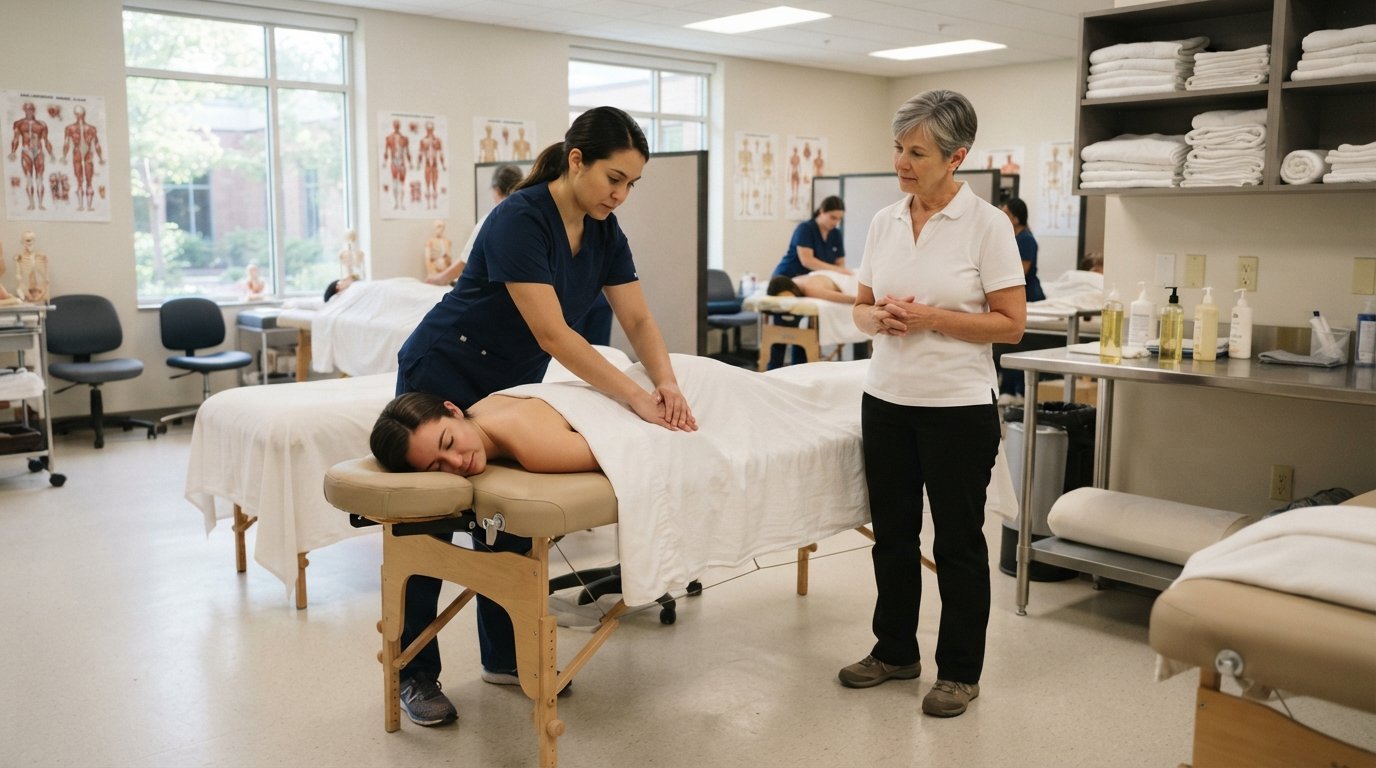
Once the basics are solid, students move into technique labs. Expect to practice Swedish massage, deep tissue work, trigger point therapy, myofascial release, and sports massage, usually in a supervised classroom with adjustable tables and professional linens. Ethics, boundaries, hygiene, and business practices round out the professional coursework. Many programs also include a student clinic, where members of the public receive discounted sessions performed by supervised students. That clinic is often the highlight of the degree: it converts classroom repetition into real client interaction, complete with intake interviews, treatment planning, and post-session documentation.
General education requirements, typically including English composition, psychology, and a humanities or social science elective, distinguish the associate degree from a certificate. These courses sharpen communication and critical thinking, skills that matter when you are explaining a treatment plan to a skeptical client or writing SOAP notes for an insurance claim. A typical course sequence might look like this:
- Semester 1: Anatomy and physiology I, introduction to massage, professionalism and ethics
- Semester 2: Anatomy and physiology II, Swedish massage techniques, kinesiology
- Semester 3: Deep tissue and advanced modalities, pathology, student clinic I
- Semester 4: Business practices, student clinic II, licensure exam preparation, general education electives
Exact sequencing varies by cohort and semester availability, so prospective students should request the current program map directly from the college. What remains consistent is the balance: roughly two-thirds of credits in massage and health sciences, one-third in general education, with clinical hours threaded throughout the second year. That balance is what makes the associate degree portable and respected in clinical, chiropractic, and spa settings alike.
Admissions, Costs, and Financial Aid Realities
Admission to a community college massage program is generally accessible but not automatic. Most applicants need a high school diploma or equivalent, completion of placement assessments in reading and math, and sometimes a brief interview or essay explaining their interest in the field. Some programs require a physical exam, proof of immunizations, and a background check before the clinical phase, since students will be touching members of the public. Because cohorts are capped by table space and instructor ratios, early application is wise, particularly for fall starts.
Tuition for in-district residents at Maryland community colleges is among the more affordable in the mid-Atlantic, and out-of-county students pay modestly higher rates. Beyond tuition, budget for textbooks, a massage table (often required for practice outside class), linens, lotions, and licensure exam fees. Many students offset these costs through federal Pell Grants, Maryland state aid, institutional scholarships, and employer tuition assistance if they already work in a spa or wellness setting. The financial aid office can package grants, work-study, and loans, and payment plans spread costs across the semester.
One practical caution: massage program costs vary widely between certificate mills and accredited college programs, and the cheapest option is not always the best value. Accreditation, licensure exam pass rates, and clinic hours are the metrics that matter. Ask the program coordinator for graduate outcomes data and verify that the curriculum meets your state's licensing board requirements, especially if you plan to practice across state lines. Prospective students who want to explore related allied health pathways before committing can browse program listings and compare options at CheapOnlineEducation, a matching service that helps learners connect with participating schools and request information without obligation.
Licensure, Career Outcomes, and What to Expect After Graduation
Graduating is not the final step: licensure is. Most states require massage therapists to pass the Massage and Bodywork Licensing Examination (MBLEx) or a state-specific exam, and Maryland issues licenses through its health occupations board. The associate degree curriculum is designed to align with these requirements, but candidates must apply, pay fees, and submit transcripts independently. Exam pass rates are a reasonable proxy for program quality, so ask about them during your research.
Career prospects for licensed massage therapists are steady. Employment settings include spas, chiropractic offices, physical therapy clinics, sports medicine practices, hospitals, and private practice. Median pay varies by region and setting, with clinical and sports-oriented roles generally paying more than resort spa positions. Many therapists build portfolio careers, combining part-time clinical work with private clients, event massage, or teaching. The associate degree opens doors that certificates sometimes cannot, particularly in healthcare settings that prefer or require formal college credentials.
Physical sustainability deserves honest mention. Massage is physically demanding work, and smart therapists protect their bodies with proper body mechanics, table height adjustment, and limits on weekly session hours. The business and ethics coursework in the degree helps graduates plan for this reality by encouraging diversified income streams and early attention to self-care. For career changers, the two-year timeline is an investment that typically pays back within a few years of full-time practice, especially when student debt is kept modest through community college pricing.
Is This In-Person Associate Degree Right for You?
The strongest candidates for a Massage Therapy/Therapeutic Massage Associate's degree, usually 2 years In-person at Allegany College of Maryland, share a few traits: comfort with close physical contact, genuine interest in anatomy, reliable attendance, and the discipline to practice techniques outside class. If you prefer asynchronous online learning, this program is not the right fit, and that is by design. Hands-on professions require hands-on training. If you are local to western Maryland or willing to relocate or commute, the program offers a credible, affordable route to licensure with strong community ties.
Before enrolling, take three concrete steps: attend an information session or meet with the program coordinator, shadow a working therapist for a day, and verify current tuition, accreditation, and licensure exam pass rates in writing. Compare at least two programs, including one certificate option, so you understand what the associate degree adds in your specific market. Ask about clinic hours, table requirements, and job placement support. These conversations cost nothing and prevent expensive surprises later.
A therapeutic massage career rewards people who are patient, curious about the human body, and committed to ongoing learning. The associate degree pathway at a community college like Allegany College of Maryland delivers the scientific grounding, supervised practice, and professional credibility that turn that interest into a sustainable livelihood. With careful planning, realistic budgeting, and a clear-eyed view of the physical demands, graduates enter a field where skilled hands and genuine care are always in demand.