
IT Certificate in Under 12 Weeks, In-Person at Amfasoft
The Information Technology Certificate, less than 12 weeks In-person at Amfasoft gives beginners hands-on IT skills and a fast path to entry-level tech roles.

You want to move into information technology, but you do not want to spend two years in a classroom before you can apply for your first help desk or IT support role. That is exactly the gap the Information Technology Certificate, less than 12 weeks In-person at Amfasoft is designed to fill. Instead of a long degree path, you get a compressed, hands-on program that meets face to face, covers the core skills employers expect from entry-level technicians, and can be finished in roughly the time it takes to complete a single college semester.
This guide breaks down what the program covers, who it suits, how to evaluate whether an in-person format is right for you, and how to connect the certificate to real job opportunities. It is written for career changers, recent high school graduates, and working adults who want a structured, fast route into technology without guessing at what to study next.
What an Information Technology Certificate Covers in Under 12 Weeks
Short-format IT certificates are built around the tasks that entry-level technicians actually perform. You are not studying abstract computer science theory or advanced software engineering. You are learning to support users, maintain hardware, troubleshoot networks, and handle the day-to-day problems that keep an organization running. The compressed timeline means the curriculum has to be tightly focused, and that focus is usually a strength for people who want employable skills quickly.
At a typical accelerated in-person program like the one at Amfasoft, you can expect the coursework to cluster around a handful of practical domains. Hardware and operating system fundamentals come first, because every support role depends on them. Networking basics follow, including IP addressing, connectivity troubleshooting, and the vocabulary of routers and switches. Security awareness, user account management, and customer service habits round out the skill set, since most entry-level IT jobs are as much about communication as they are about technology.
Here is a realistic picture of the topic areas a sub-12-week IT certificate tends to prioritize:
- Computer hardware, peripherals, and operating system installation and configuration
- Networking fundamentals, including connectivity testing and basic troubleshooting
- Security essentials such as passwords, access control, and recognizing common threats
- Help desk workflows, ticketing, documentation, and professional user support
- Exam preparation for entry-level industry certifications where the program includes it
The exact syllabus varies by provider, so confirm the module list and any included certification vouchers directly with Amfasoft before you enroll. What matters is that the training is hands-on and aligned with the job you want, not just a survey of topics. A good accelerated program will have you physically working with hardware, configuring systems, and practicing support scenarios rather than only reading slides.
Why the In-Person Format at Amfasoft Matters
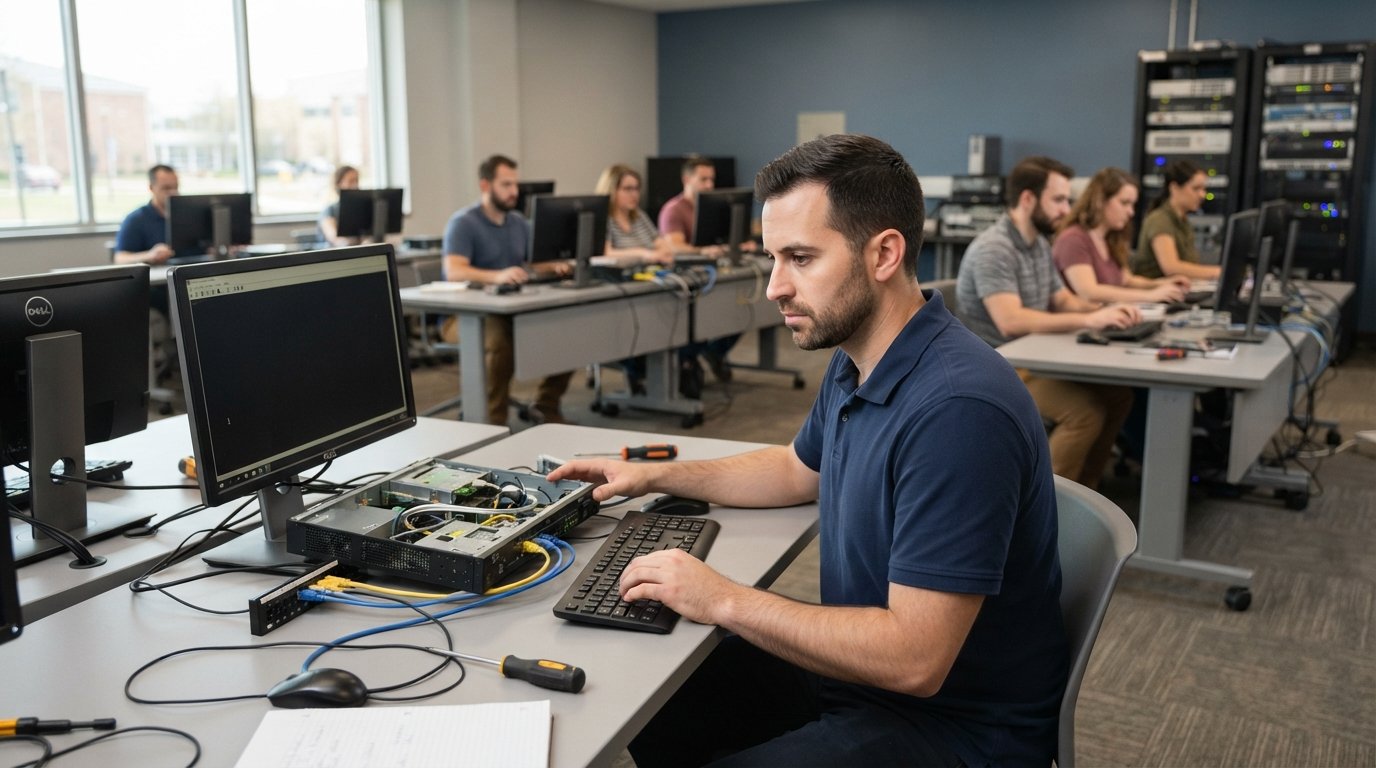
Online IT training is convenient, but a hands-on certificate in a physical lab offers something self-paced courses often struggle to replicate: immediate feedback. When you are cabling a machine, swapping a component, or troubleshooting a network fault, an instructor standing next to you can spot the mistake in seconds and explain it in context. That real-time correction is especially valuable for beginners who do not yet know what they do not know.
The in-person setting also builds the professional habits that employers notice. Showing up on a schedule, collaborating with classmates on a lab exercise, and explaining a technical problem clearly to another person are all part of the job. A classroom environment naturally rehearses those behaviors. For adult learners returning to education after years away, the structure of a scheduled, face-to-face program can also be easier to stick with than a self-directed course that competes with everything else on your calendar.
Amfasoft's compressed schedule is another practical advantage. Because the program runs in less than 12 weeks, you can plan around a defined start and end date rather than an open-ended commitment. That makes it easier to arrange childcare, negotiate a temporary schedule change with an employer, or line the certificate up with a job search that begins the moment you finish.
Who Should Consider a Sub-12-Week IT Certificate
The strongest candidates for an accelerated IT certificate are people who need a credential and a skill set quickly, and who are prepared to treat the program like a full-time commitment for a few months. This is not a leisurely enrichment course. The pace is intentionally brisk, and the students who succeed are usually the ones who arrive with a clear goal, whether that is a first IT job, a promotion, or a transition out of an unrelated field.
Career changers are a natural fit. If you have spent years in retail, hospitality, logistics, or administration and you want to move into technology, a short certificate gives you a credible way to demonstrate foundational skills without starting a multi-year degree. Recent high school graduates who are not ready for a four-year college, or who want to earn while they learn, also benefit from a focused, hands-on program. Working adults who already use technology daily often find the material approachable and the schedule manageable.
It is equally important to be honest about who should look elsewhere. If your goal is software development, advanced cybersecurity analysis, or a role that requires a bachelor's degree, a short IT certificate is a starting point rather than a destination. If you cannot commit to the in-person schedule, a different format may serve you better. And if you are comparing multiple program types, it helps to understand how certificates differ from longer credentials, which is something we cover in our guide to the COD Electrical Engineering Technology Certificate Guide. That comparison can clarify whether a short, focused certificate or a broader technical program matches your career timeline.
How to Evaluate the Amfasoft Program Before You Enroll
Before you commit to any accelerated program, treat the enrollment decision like a small research project. You want to confirm that the curriculum matches the jobs you are targeting, that the schedule is genuinely workable, and that the cost is transparent. A few direct questions to the provider will save you from surprises later.
Ask for the full module list, the weekly time commitment, and whether the program includes any industry certification exams or vouchers. Confirm the total cost, including materials and any exam fees, and ask what happens if you need to miss a session. Also ask about completion outcomes and what kind of job search support, if any, is available after the program ends. These details matter more than marketing language.
A simple evaluation checklist can keep the conversation focused:
- Confirm the exact start and end dates and the weekly hours required.
- Request the full syllabus and verify it covers hardware, networking, security, and support skills.
- Ask whether certification exam preparation and vouchers are included.
- Clarify total cost, refund policy, and attendance requirements.
- Ask what graduates typically do next and whether job placement assistance is offered.
Once you have those answers, compare them against your own constraints. If the schedule fits, the syllabus is practical, and the cost is clear, an accelerated program can be a sensible investment. If any of those pieces are vague, keep asking questions. A reputable provider will welcome them.
Building a Career Path After the Certificate
Finishing the certificate is the beginning of the career path, not the end of it. The most common entry point is a help desk or IT support role, where you handle user issues, document fixes, and learn how a real organization's technology stack works. From there, technicians often specialize in networking, systems administration, cybersecurity, or cloud support. Each specialization usually pairs well with a next-level certification, and many employers support continued training once you are on staff.
It also helps to think about how this certificate fits into a longer educational plan. Some graduates use a short IT credential as a stepping stone toward an associate or bachelor's degree, applying the hands-on skills they learned while they continue studying. If you are weighing online versus campus options for that next step, a matching service can help you compare programs without an obligation to apply. For example, CheapOnlineEducation lets prospective students browse sponsored online and campus programs by subject and request information from schools that fit their goals. That kind of low-pressure comparison is useful when you are planning the move from a certificate to a degree.
Alongside formal education, build a small portfolio of proof. Document the labs you complete, write short notes on problems you solved, and practice explaining technical concepts in plain language. Entry-level hiring managers care about whether you can diagnose an issue and communicate the fix, and a certificate program gives you plenty of material to draw on in interviews.
Making the Most of the 12-Week Window
The compressed timeline rewards preparation. Before the program starts, get organized: set up a study space, block your calendar for class and review time, and tell the people around you that you will be busy for a few months. Small logistical decisions made in advance protect the momentum you will need once the pace picks up.
During the program, treat every lab as practice for a real job. Take notes on the steps you follow, ask the instructor to explain the reasoning behind a fix, and review your weakest topics the same week you encounter them. If the program prepares you for an entry-level certification exam, schedule the exam near the end of the course so the material is fresh. Finally, start your job search before the final week. Update your resume with the skills you have learned, reach out to local employers, and ask the program staff about any employer connections they maintain.
The Information Technology Certificate, less than 12 weeks In-person at Amfasoft is best understood as a fast, structured on-ramp to a technical career. It will not replace experience, and it will not guarantee a job, but it can give you the foundational skills, the hands-on practice, and the credential to start applying with confidence. If the schedule and syllabus line up with your goals, the short timeline is exactly what makes it worth considering.