
EMT Paramedic Certificate in Under 12 Weeks at Tri-C
The Emergency Medical Technology/Technician (EMT Paramedic) Certificate, less than 12 weeks In-person at Cuyahoga Community College turns beginners into certified EMS professionals fast.

By Leslie Wulfert
When someone collapses from cardiac arrest in a grocery store aisle or a teenager suffers a spinal injury on a football field, the first trained professional on scene is often an EMT or paramedic. That response depends on rigorous, fast-paced training that transforms ordinary people into confident emergency caregivers. For anyone in Northeast Ohio who wants to enter that world quickly, the Emergency Medical Technology/Technician (EMT Paramedic) Certificate, less than 12 weeks In-person at Cuyahoga Community College offers a compact, hands-on route into emergency medical services. Instead of spending two years on a traditional degree before touching a patient, students in this program move through intensive classroom instruction, skills labs, and clinical rotations in a matter of months, then sit for state or national certification exams ready to work.
This article breaks down what the certificate covers, who it suits, how to get admitted, what it costs, and how it connects to real careers in EMS, fire service, and hospital settings. It also explains how Cuyahoga Community College (commonly called Tri-C) structures its emergency medical technology pathway, and why the in-person format matters for a field where you literally hold lives in your hands. If you have been searching for a fast, credible way to start a healthcare career without a multi-year commitment, this program deserves a close look. And if you want to compare it side by side with other certificate options, tools like the program matching service at HigherEducationAdvisor.com let you explore sponsored listings by field and state with no obligation to apply.
Why Emergency Medical Technology Is a Smart Career Entry Point
Emergency medical services sit at the intersection of public safety and healthcare, two sectors that consistently need trained personnel. The Bureau of Labor Statistics projects steady demand for EMTs and paramedics over the next decade, driven by aging populations, more frequent natural disasters, and the expansion of community paramedicine programs that send medics to patients' homes. Unlike many healthcare roles, EMS does not require a four-year degree for entry. A certificate plus certification opens the door to ambulance services, fire departments, hospitals, and event medical teams.
The work itself is varied. One shift might involve stabilizing a stroke patient and coordinating with a trauma center, the next might involve reassuring a frightened child with a broken arm. EMTs and paramedics assess conditions, administer certain medications, perform CPR and airway management, immobilize fractures, and transport patients safely. It is physical, emotional, and deeply human work. For career changers coming from retail, food service, or office jobs, the appeal is obvious: a defined skill set, a clear credential, and the chance to do something that matters every single shift. The Emergency Medical Technology/Technician (EMT Paramedic) Certificate, less than 12 weeks In-person at Cuyahoga Community College is built precisely for people who want that transition to happen fast.
There is also a ladder to climb. Many students begin with the basic EMT certificate, work for a while, then return for paramedic training or advanced certifications. Some go on to fire science, nursing, or physician assistant programs. The certificate is not a dead end; it is a launch pad. Starting with a short, in-person program at a community college keeps costs low and keeps you close to the clinical partners who may eventually hire you.
Inside the EMT Paramedic Certificate at Cuyahoga Community College
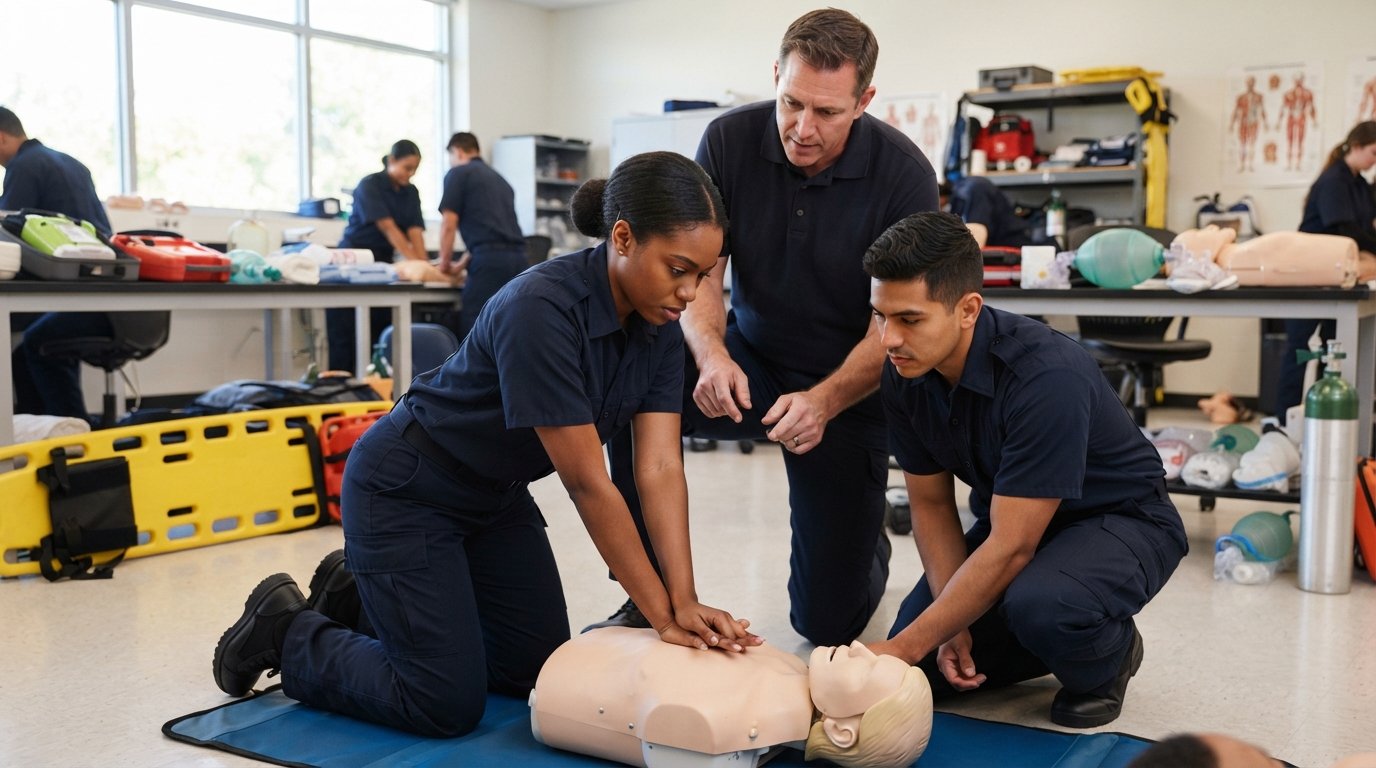
Cuyahoga Community College, widely known as Tri-C, operates one of Ohio's established emergency medical technology programs. The Emergency Medical Technology/Technician (EMT Paramedic) Certificate, less than 12 weeks In-person at Cuyahoga Community College is designed as an accelerated entry into the field. Coursework blends lecture, hands-on skills practice, and supervised clinical experience. Because the format is in person, students practice airway adjuncts, bag-valve-mask ventilation, spinal immobilization, and patient assessment on real equipment with instructors correcting technique in real time. That tactile feedback is difficult to replicate online, and in EMS it is essential.
The curriculum typically follows a sequence that builds from foundational knowledge to advanced skills. Early weeks cover anatomy and physiology, medical terminology, legal and ethical issues, and scene safety. Mid-program content moves into patient assessment, cardiac emergencies, trauma, obstetrics, pediatrics, and pharmacology basics. Later weeks focus on clinical rotations and preparation for the certification exam. Students who complete the certificate are eligible to sit for the National Registry of Emergency Medical Technicians (NREMT) exam, which is required for state licensure in Ohio and most other states.
Here is a simplified look at what the program generally includes:
- Classroom instruction in emergency medical theory and patient care protocols
- Skills labs where students practice assessments, CPR, airway management, and immobilization
- Clinical or field rotations with ambulance services, fire departments, or hospitals
- Exam preparation for the NREMT cognitive and psychomotor assessments
- CPR and first aid certification, often embedded within the program
Because the program is compressed into less than 12 weeks, attendance is not optional. Missing a skills session can mean falling behind quickly. Prospective students should plan for a schedule that resembles a full-time job, with daytime or evening cohorts depending on the term. Tri-C typically offers the program at its Metropolitan or Western campus, and students should confirm current locations and start dates directly with the college, since offerings shift from semester to semester. The intensity is real, but so is the payoff: in roughly the time it takes to complete a single college semester, you can be eligible for entry-level EMS employment.
Admission Requirements and How to Apply
Admission to the Emergency Medical Technology/Technician (EMT Paramedic) Certificate, less than 12 weeks In-person at Cuyahoga Community College follows a structured process. Applicants must be at least 18 years old, hold a high school diploma or GED, and meet college placement standards in reading and math. Most students also need current CPR certification at the healthcare provider level, a clean background check, a drug screen, and up-to-date immunizations including hepatitis B, MMR, and varicella. These requirements exist because students will be in clinical settings with vulnerable patients.
The application steps generally look like this:
- Apply to Cuyahoga Community College as a credit student and obtain a student ID.
- Submit official high school transcripts or GED scores to the admissions office.
- Complete placement testing or provide qualifying ACT, SAT, or prior college transcripts.
- Attend a mandatory program information session or advising appointment.
- Submit health forms, background check, and CPR certification before the clinical portion begins.
Because the program fills quickly and has limited lab space, early application matters. Students who wait until the week before classes often find themselves on a waitlist for the next term. It also helps to speak with an academic advisor about financial aid, since certificate programs at community colleges frequently qualify for federal grants, workforce development funds, and employer tuition assistance. Tri-C's financial aid office can clarify which options apply, but prospective students should treat any specific cost figure as an estimate and confirm current tuition and fees with the college.
What the In-Person Format Adds to Your Training
Online learning has transformed many fields, but emergency medicine is not one of them. The Emergency Medical Technology/Technician (EMT Paramedic) Certificate, less than 12 weeks In-person at Cuyahoga Community College leans into hands-on instruction for good reason. When you are learning to insert an airway device or run a cardiac arrest scenario, your instructor needs to see your hands, your posture, and your decision-making under pressure. Simulation labs allow students to make mistakes safely, then repeat the skill until it becomes automatic.
In-person cohorts also build the teamwork that EMS depends on. Paramedics and EMTs work in pairs and coordinate with firefighters, police, and hospital staff. Practicing communication and role assignment in a classroom translates directly to the field. Many students report that the relationships formed during an accelerated certificate program become their first professional network, leading to job leads and shift swaps long after graduation. For anyone weighing online versus on-campus options, this is a case where the in-person requirement is a feature, not a bug.
Students who prefer to explore other healthcare or education pathways before committing can browse certificate and degree listings by field and state through the Early Childhood Education Certificate at Centralia College guide, which shows how short programs in other disciplines are structured. Comparing formats across fields helps you decide whether an accelerated, in-person model fits your learning style and schedule.
Costs, Financial Aid, and Return on Investment
Community college certificate programs are generally far less expensive than private EMS academies or four-year degrees. Tuition for the Emergency Medical Technology/Technician (EMT Paramedic) Certificate, less than 12 weeks In-person at Cuyahoga Community College is set by the college and varies for in-district, out-of-district, and out-of-state students. Additional costs may include uniforms, stethoscope, trauma shears, background check fees, immunizations, and exam fees for the NREMT. Prospective students should request a current cost sheet from Tri-C's program office rather than relying on older figures.
Financial support options often include:
- Federal Pell Grants for eligible low-income students
- Ohio workforce development or incumbent worker training funds
- Employer tuition reimbursement for current fire or security personnel
- Scholarships through local EMS agencies or foundations
- Payment plans offered directly by the college
Return on investment depends on how quickly you find work and how many hours you pick up. Entry-level EMT pay in Ohio typically starts modestly, but paramedics, fire-based EMS, and hospital-based technicians earn more. Many students work as EMTs while pursuing paramedic certification, using employer tuition benefits to offset the next credential. The key is to treat the certificate as step one, not the finish line. Within a few years, a motivated graduate can move from EMT to paramedic to supervisor or educator, each step adding pay and responsibility.
Career Paths After Certification
Graduates of the Emergency Medical Technology/Technician (EMT Paramedic) Certificate, less than 12 weeks In-person at Cuyahoga Community College pursue a range of roles. Private ambulance companies hire continuously, and municipal fire departments often require EMT certification as a minimum qualification. Hospitals employ EMTs and paramedics in emergency departments, urgent care centers, and inter-facility transport teams. Additional settings include event medicine at stadiums and concerts, industrial safety teams at manufacturing plants, and ski patrol or wilderness rescue operations.
Career progression often looks like this: start as an EMT, gain field experience, return for paramedic certification, then consider specialties such as critical care transport, community paramedicine, or flight medicine. Some graduates pivot into teaching, becoming instructors for CPR or EMT programs. Others use the credential as a stepping stone into nursing, respiratory therapy, or physician assistant studies. The clinical hours and patient contact accumulated during the certificate program strengthen applications to those advanced programs.
For students who want to compare EMS training with other vocational paths, a matching platform such as TopStudents can help you browse online and on-campus programs by subject and state, then request information from schools that fit your goals. It is a low-pressure way to see what else is available before committing to a single program.
Tips for Succeeding in an Accelerated Program
Twelve weeks is not a long time, and the pace can feel overwhelming if you are not prepared. Successful students treat the program like a full-time job. They review notes daily, practice skills outside of class with classmates, and ask instructors for feedback early rather than waiting until exam week. Study groups are common and effective, especially for pharmacology and cardiology content that rewards repetition.
Physical and mental preparation also matters. EMS work involves lifting, kneeling, and standing for long periods. Students who begin a basic fitness routine before the program starts tend to handle skills labs more comfortably. Emotionally, it helps to anticipate that you will encounter difficult scenarios, including simulated pediatric emergencies and trauma. Instructors are trained to debrief these experiences, and students should use those debriefs to process what they felt, not just what they did.
Finally, secure your logistics before day one. Confirm childcare, transportation, and work schedule adjustments. Because the Emergency Medical Technology/Technician (EMT Paramedic) Certificate, less than 12 weeks In-person at Cuyahoga Community College requires consistent attendance, any conflict that causes missed sessions can jeopardize completion. Plan for the worst-case commute and build in buffer time. The students who finish strong are usually the ones who cleared their calendar and committed fully from the first day.
Emergency medical technology is one of the few fields where you can go from curious beginner to certified professional in a single season. The Emergency Medical Technology/Technician (EMT Paramedic) Certificate, less than 12 weeks In-person at Cuyahoga Community College offers a focused, affordable, and hands-on path into that world. If you are ready to trade a desk for an ambulance, the next step is simple: contact Tri-C's program office, attend an information session, and start your application. The sooner you begin, the sooner you can be the person someone calls when every second counts.