
EMT Paramedic Associate's Degree at Central Arizona College
Earn your EMT Paramedic Associate's degree in about 2 years at Central Arizona College. In-person training, clinical rotations, and a clear path to certification.

By Margaret Reis
An emergency call comes in at 2 a.m. A patient is unresponsive, and the next few minutes will determine whether they survive. The professionals who respond are not just drivers with first aid kits; they are highly trained clinicians who deliver advanced life support in the back of a moving vehicle. If you want to be that person, the Emergency Medical Technology/Technician (EMT Paramedic) Associate's degree, usually 2 years In-person at Central Arizona College, is a direct route to a career where every shift matters. This program combines rigorous classroom instruction with hands-on clinical rotations, preparing you for the National Registry of Emergency Medical Technicians (NREMT) exams and a role that is in steady demand across Arizona and the nation.
Central Arizona College (CAC) offers this Associate of Applied Science (AAS) degree at its Signal Peak and Superstition Mountain campuses, with some cohorts starting annually. The curriculum is designed to take you from a basic EMT to a paramedic capable of interpreting EKGs, administering medications, and making split-second decisions. Because the program is in-person, you will spend significant time in simulation labs and on ambulances, building the muscle memory and communication skills that online programs struggle to replicate. For students who thrive under pressure and want a credential that leads directly to employment, this degree is a practical, respected choice.
What the EMT Paramedic Associate's Degree Covers
The Emergency Medical Technology/Technician (EMT Paramedic) Associate's degree, usually 2 years In-person at Central Arizona College, is structured to meet the latest national EMS education standards. You will begin with foundational courses in anatomy, physiology, and medical terminology, then progress to advanced patient assessment, pharmacology, cardiology, and trauma management. The program also includes general education requirements in English, math, and social sciences, which broadens your critical thinking and communication abilities, skills that are essential when you are calming a frightened family or briefing a hospital team.
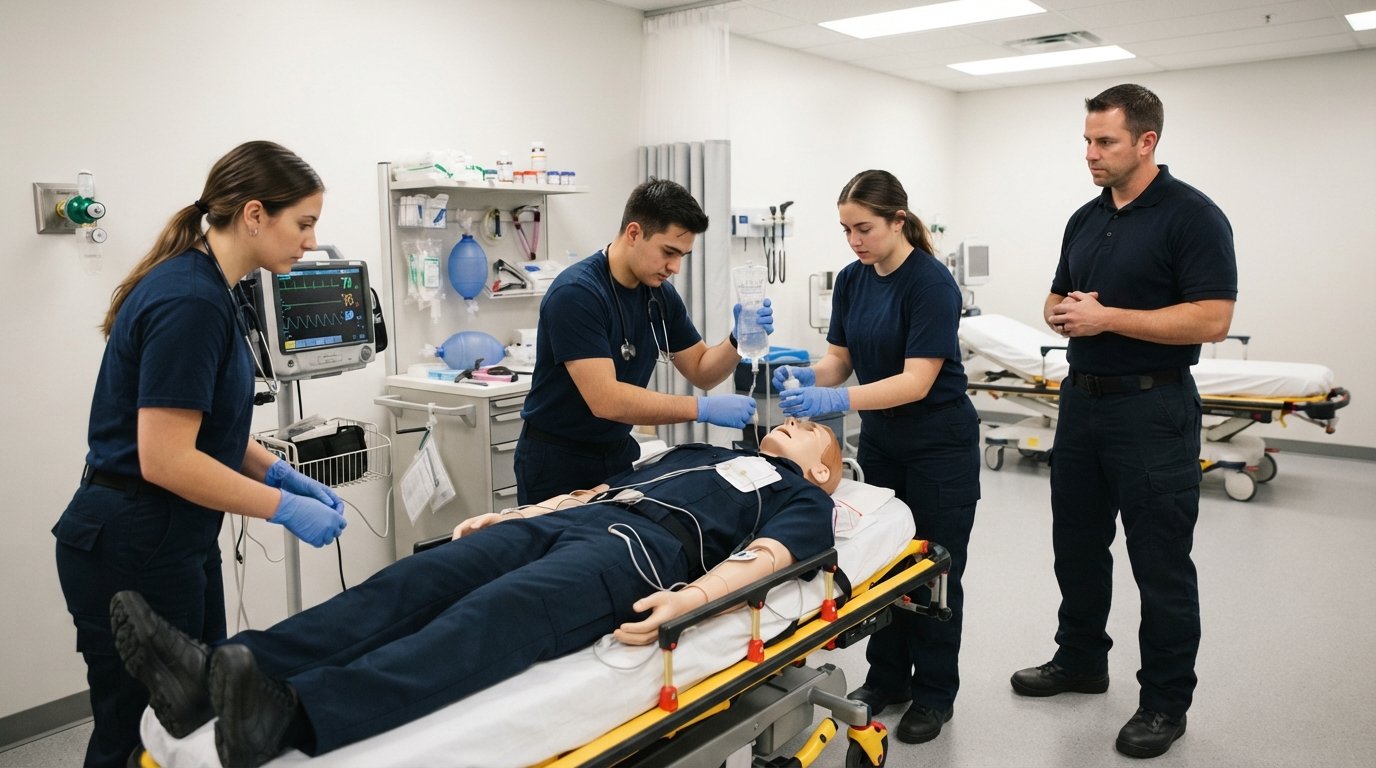
Hands-on training is the backbone of the degree. You will practice intubation, IV therapy, medication administration, and cardiac rhythm interpretation in high-fidelity simulation labs. Later, you will complete clinical rotations in emergency departments, operating rooms, and intensive care units, plus field internships with local fire departments and ambulance services. These experiences expose you to the unpredictable nature of emergency medicine and help you build a professional network before you graduate.
Here is a snapshot of the core areas you will study:
- Advanced Airway Management: Endotracheal intubation, supraglottic airways, and surgical cricothyrotomy.
- Cardiology: 12-lead EKG interpretation, defibrillation, synchronized cardioversion, and cardiac pharmacology.
- Trauma Care: Hemorrhage control, fracture stabilization, spinal immobilization, and rapid transport decisions.
- Medical Emergencies: Management of respiratory, neurological, endocrine, and allergic reactions.
- Special Populations: Pediatric, obstetric, geriatric, and psychiatric emergencies.
Each of these topics is tested on the NREMT paramedic exam, and CAC's program is designed to align with those national standards. The general education courses, while not directly clinical, help you understand research, write patient care reports, and communicate effectively with diverse populations. By the end of the two years, you will have the knowledge and the hours required to sit for certification.
Admission Requirements and How to Prepare
Getting into the paramedic program at Central Arizona College is competitive, and the admissions process has several gates. Before you can enroll in the core paramedic courses, you must already hold a current Arizona EMT certification (or NREMT EMT certification) and have documented patient care experience. Many applicants work as EMTs for a year or more before applying, which strengthens their clinical judgment and their application.
You will also need to complete prerequisite courses such as anatomy and physiology, medical terminology, and college-level math and English. Some of these can be taken online or at a nearby campus, but the paramedic core is delivered in person. A background check, drug screen, immunizations, and CPR certification for healthcare providers are also required before clinical rotations. Because the program is cohort-based, you will move through the advanced courses with the same group of peers, which fosters teamwork and mutual support.
To improve your chances, consider these steps:
- Earn your EMT certification and gain at least six months of field experience.
- Complete all prerequisite courses with a grade of C or higher.
- Attend a program information session and meet with an academic advisor.
- Submit your application early, as seats fill quickly.
- Prepare for the TEAS or HESI entrance exam if required.
Advisors at CAC can help you map out a timeline, especially if you are balancing work and family. For students who need flexibility in the early stages, some prerequisites may be available through online formats, but the paramedic core remains in-person. If you are exploring other health science pathways as a backup, a guide on the Health Sciences Associate Degree at Collin College offers a useful comparison for how two-year programs are structured.
Cost, Financial Aid, and Return on Investment
Tuition for the Emergency Medical Technology/Technician (EMT Paramedic) Associate's degree, usually 2 years In-person at Central Arizona College, is set per credit hour, and the total cost depends on whether you are a resident of Pinal County or an out-of-county or out-of-state student. In addition to tuition, you should budget for textbooks, uniforms, stethoscope, liability insurance, and exam fees. However, financial aid, scholarships, and payment plans can reduce the out-of-pocket burden. CAC participates in federal student aid programs, and the Arizona Promise Program may cover tuition for eligible students.
From a return-on-investment perspective, paramedics in Arizona earn a median annual salary in the mid-$40,000s to low-$50,000s, with opportunities for overtime and shift differentials. Fire departments and private ambulance services often offer benefits and retirement plans. Many graduates continue to a bachelor's degree in emergency management, public health, or nursing, which can open doors to supervisory, teaching, or critical care transport roles. The degree is a stepping stone, not a dead end.
To keep costs manageable, consider applying for FAFSA early, searching for local EMS scholarships, and asking your employer about tuition reimbursement if you already work in a related field. Some students work part-time as EMTs while completing the paramedic program, which provides income and valuable experience. The key is to plan your finances before you start, so you can focus on your studies once the clinical rotations begin.
Career Outlook and Paramedic Job Duties
Demand for paramedics is projected to grow faster than the average for all occupations over the next decade, driven by an aging population and an increased emphasis on emergency preparedness. In Arizona, rural communities often face a shortage of advanced life support providers, so graduates willing to work in underserved areas may find even more opportunities. Your day-to-day duties will vary by setting, but common tasks include responding to 911 calls, assessing patients, providing advanced airway management, administering medications, interpreting EKGs, and transporting patients to hospitals.
Paramedics also work in non-traditional settings such as urgent care clinics, industrial sites, and event medical services. Some pursue flight paramedic roles, which require additional certification and experience. The Associate's degree gives you a broader educational foundation than a certificate alone, which can be advantageous if you later seek leadership roles or teaching positions.
If you are still exploring your options and want to compare programs from multiple schools, a free matching service like TopStudents can help you browse online and on-campus degrees and request information without obligation. This is especially useful if you are considering backup plans or want to see how CAC's program compares to others in the region.
Why Choose Central Arizona College for Your Paramedic Training
Central Arizona College has a long history of training EMS professionals for the region. Its paramedic program is accredited by the Commission on Accreditation of Allied Health Education Programs (CAAHEP), which means it meets rigorous national standards. The faculty are experienced paramedics and educators who bring real-world stories into the classroom. Class sizes are small enough that you get individual attention in the simulation lab, yet large enough to practice team-based care.
The college also maintains strong partnerships with local fire departments, hospitals, and ambulance services. These relationships translate into clinical placement opportunities and sometimes job offers before graduation. The in-person format allows for immediate feedback on your technique, which is critical when you are learning to start an IV or manage a cardiac arrest. While online programs exist for some health sciences, emergency medicine is a contact sport; you need to be in the room, practicing with your hands and communicating with your team.
Beyond the classroom, CAC offers student support services such as tutoring, advising, and disability accommodations. If you are a veteran, career changer, or first-generation college student, you will find resources to help you succeed. The college's locations in Pinal County make it accessible for residents of Casa Grande, Apache Junction, and surrounding communities. For those who need to relocate, the low cost of living in the area is an added benefit.
Steps to Enroll and Start Your EMS Career
If you are ready to pursue the Emergency Medical Technology/Technician (EMT Paramedic) Associate's degree, usually 2 years In-person at Central Arizona College, here is a practical roadmap. First, apply to the college and submit official transcripts. Second, meet with an academic advisor to review your prerequisite courses and create a plan. Third, complete the program-specific application, which may include a background check and essay. Fourth, attend orientation and purchase your supplies. Finally, commit to the schedule, because the program is demanding and requires focus.
It is also wise to shadow a paramedic or ride along with a local ambulance service before you enroll. That experience will confirm whether the adrenaline-filled, unpredictable nature of the job is right for you. If it is, the two years will pass quickly, and you will emerge with a credential that lets you make a difference on the worst day of someone's life. The need for skilled paramedics is not going away, and Central Arizona College's program is one of the most direct paths to joining the ranks.