
Clackamas CC Biology Associate's Degree: 2-Year In-Person
Earn a Biology/Biological Sciences, General Associate's degree, usually 2 years In-person at Clackamas Community College and build a low-cost transfer path to a four-year science degree.

By Leo Parker
Choosing a path in the biological sciences opens doors to careers in healthcare, research, education, and environmental management. For students in Oregon who want a strong, affordable foundation before transferring to a four-year university, the Biology/Biological Sciences, General Associate's degree, usually 2 years In-person at Clackamas Community College, is a standout option. This program combines rigorous coursework in cellular biology, ecology, genetics, and chemistry with hands-on laboratory experience, all delivered on a campus that supports direct mentorship and real-time collaboration. Whether you are a recent high school graduate, an adult learner returning to school, or a career changer drawn to the life sciences, understanding what this degree offers can help you decide if it aligns with your goals. This guide breaks down the program structure, admission steps, transfer pathways, costs, and career outlook so you can move forward with confidence.
Why Choose the Biology Associate's Degree at Clackamas Community College?
Clackamas Community College (CCC) sits in Oregon City, just a short drive from Portland, and serves thousands of students each year through career-technical and transfer-focused programs. The general Associate of Science in Biology is designed for students who plan to transfer to a four-year institution to complete a bachelor's degree in biology, environmental science, public health, or a related field. Because the program is delivered entirely in person, students benefit from face-to-face instruction, access to laboratory equipment, and the kind of spontaneous collaboration that is hard to replicate online.
One of the strongest arguments for starting at a community college is cost. CCC's tuition is significantly lower than that of most four-year universities in Oregon, and students can complete their general education and lower-division science requirements without taking on heavy debt. Small class sizes in biology and chemistry labs mean more individual attention from instructors, which is especially valuable in subjects where hands-on technique matters. The in-person format also makes it easier to form study groups, join science clubs, and build relationships with faculty who can write recommendation letters for scholarships or transfer applications.
For students who are still exploring their options, it helps to compare this program with similar offerings elsewhere. For example, our guide to the Health Sciences Associate Degree at Collin College shows how another two-year path structures its science curriculum. Seeing how different colleges organize their biology and health science tracks can clarify what to look for in a program, whether you stay in Oregon or consider schools in other states.
Program Structure and Coursework
The general biology associate's degree typically requires around 90 credits, which most full-time students complete in two years. The curriculum blends foundational science courses with general education requirements in writing, mathematics, and social sciences. Core biology courses usually include general biology, cell biology, genetics, ecology, and anatomy and physiology, while chemistry, physics, and math support the scientific reasoning that upper-division coursework will demand.
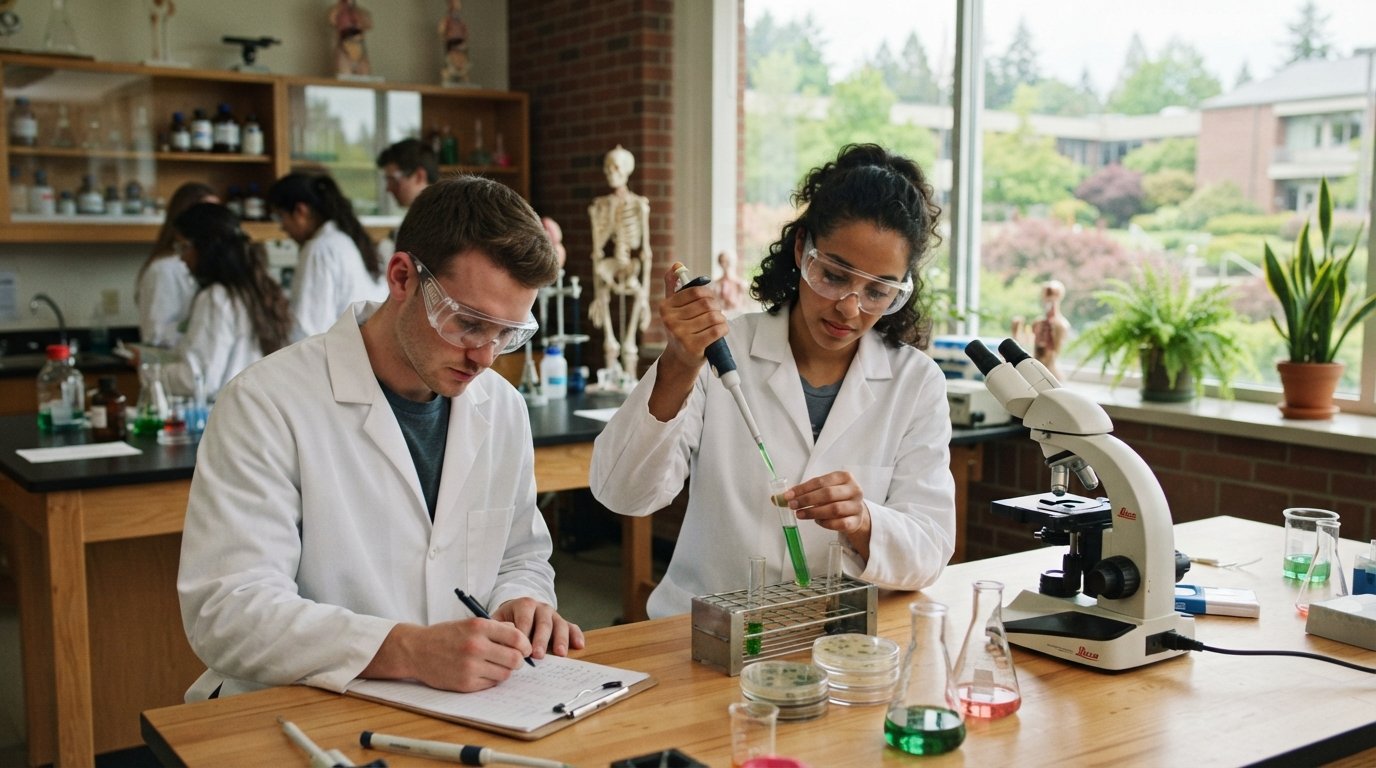
Laboratory work is a central feature of the program. Students spend significant time in wet labs performing experiments, learning microscopy, conducting dissections, and analyzing data. Because the program is in person, students work directly with lab instructors and lab partners, which builds both technical skills and teamwork. Many courses also include field components, particularly in ecology and environmental science, where students may collect samples or observe local ecosystems.
Transfer advising is built into the experience. Students work with academic advisors to select electives that satisfy the requirements of their intended four-year institution. Oregon's transfer module and articulation agreements help ensure that credits earned at CCC count toward a bachelor's degree at public universities in the state. Here is a snapshot of what the degree typically covers:
- General biology sequence with laboratory (cells, genetics, evolution, ecology)
- General chemistry sequence with laboratory
- Organic chemistry or additional science electives, depending on transfer goals
- College-level mathematics, often statistics or calculus
- Written communication and general education electives
Students should confirm specific course requirements with a CCC advisor, since transfer targets vary by university and major. For instance, a student planning to study nursing or medical technology may need different electives than someone aiming for a research career in molecular biology.
Admission Requirements and Enrollment Steps
Clackamas Community College maintains an open-door admission policy, meaning most students who apply are accepted. However, the biology program does have placement requirements for math and writing, and students may need to complete developmental coursework before enrolling in college-level biology or chemistry. Prospective students should plan for placement testing or submit prior transcripts to determine the right starting point.
The enrollment process is straightforward and can be completed in a few steps. Applying early gives students the best chance of securing financial aid and registering for required courses before seats fill. Here is a general sequence to follow:
- Complete the CCC online admission application and pay any application fee.
- Submit official high school transcripts or equivalency documents.
- Take placement assessments in math, reading, and writing, or submit SAT, ACT, or prior college credit.
- Meet with an academic advisor to map out a two-year plan and confirm transfer requirements.
- Apply for financial aid by completing the FAFSA, and explore scholarships through the CCC foundation.
- Register for classes during the priority registration window and attend orientation.
Students who are unsure about their readiness for college-level science should ask about tutoring, supplemental instruction, and summer bridge programs. CCC offers support services that help students strengthen study skills and adjust to the pace of college coursework. Because the biology degree is in person, students should also plan their schedule around lab times, which may include afternoon or evening sessions.
Transfer Pathways to Four-Year Universities
Most students who earn a general biology associate's degree intend to transfer. In Oregon, popular destinations include Oregon State University, Portland State University, the University of Oregon, and Southern Oregon University, as well as private institutions like Reed College and Pacific University. Each school has its own transfer requirements, but the Associate of Science in Biology is designed to satisfy lower-division major requirements at many of them.
Transfer students should begin planning early. Advisors recommend identifying two or three target universities during the first year and reviewing their program requirements for the intended major. Some universities require specific sequences in organic chemistry or calculus that may not be part of the default CCC degree plan, so students may need to use electives to fill those gaps. Articulation agreements and transfer guides published by CCC and the receiving institutions can help students avoid taking courses that will not count.
Students who want to explore online and campus degree options beyond Oregon can use matching services to compare programs by field and state. One such resource is CheapOnlineEducation, which helps prospective students browse sponsored programs and request information from colleges that fit their goals. For students considering a hybrid path, where some upper-division coursework is completed online, these comparison tools can be useful for weighing cost, flexibility, and program reputation.
Costs, Financial Aid, and Value
Community college tuition is one of the most effective ways to reduce the overall cost of a bachelor's degree. At CCC, students pay per credit, and the total cost of the associate's degree is typically a fraction of what two years at a four-year university would cost. Books, lab fees, and supplies add to the total, but financial aid and scholarships can offset much of the expense.
Students should complete the Free Application for Federal Student Aid (FAFSA) as early as possible. Federal Pell Grants, state grants, work-study, and loans may be available depending on financial need. The CCC Foundation also awards scholarships to students in science programs, and some employers offer tuition assistance for employees pursuing degrees in healthcare or laboratory science. It is worth speaking with the financial aid office to understand all options before assuming the program is out of reach.
Beyond tuition, students should consider the return on investment. Biology-related careers vary widely in salary, but many roles in healthcare, environmental consulting, and biotechnology offer solid earning potential with a bachelor's degree or higher. Starting at CCC keeps debt low, which makes it easier to pursue advanced study if that becomes necessary.
Career Outlook and Next Steps After Graduation
Graduates with an associate's degree in general biology can pursue entry-level positions in laboratories, environmental organizations, parks and recreation departments, and healthcare settings. Some roles, such as laboratory technician or environmental sampling assistant, may be available with the associate's degree alone, while others require a bachelor's degree or specialized certification. Many students use the degree as a stepping stone to careers in nursing, dentistry, veterinary medicine, pharmacy, or scientific research.
According to the U.S. Bureau of Labor Statistics, employment in life, physical, and social science occupations is projected to grow over the next decade, with demand driven by healthcare, environmental protection, and biotechnology. Students who continue to a bachelor's degree will have access to a broader range of positions, including research assistant, quality control analyst, and biology teacher. Those who pursue graduate study can move into advanced research, academia, or leadership roles in industry.
It is important to note that career outcomes depend on many factors, including location, experience, and further education. Students should use the CCC career center to explore internships, job shadowing, and networking opportunities while enrolled. Building a resume with laboratory experience and relevant part-time work can make the transition to a four-year school or the workforce smoother.
Is the In-Person Format Right for You?
The in-person format at Clackamas Community College offers distinct advantages for biology students. Hands-on lab work, direct access to instructors, and the structure of a campus environment can help students stay motivated and develop strong study habits. For students who thrive in collaborative settings or who need extra support in science and math, the face-to-face experience can be a major asset.
However, in-person study also requires scheduling flexibility. Students who work full time or have caregiving responsibilities should review course times and consider whether they can commit to daytime or evening labs. CCC offers advising and support services to help students balance school with other obligations, and some general education courses may be available in hybrid or online formats to add flexibility.
Prospective students who are unsure whether the biology associate's degree is the right fit can request information from CCC, speak with an advisor, or attend an information session. Exploring program listings and comparing options through education matching services can also help clarify goals before committing to a two-year plan. With careful planning, the Biology/Biological Sciences, General Associate's degree, usually 2 years In-person at Clackamas Community College, can be a smart, affordable first step toward a rewarding career in the life sciences.