
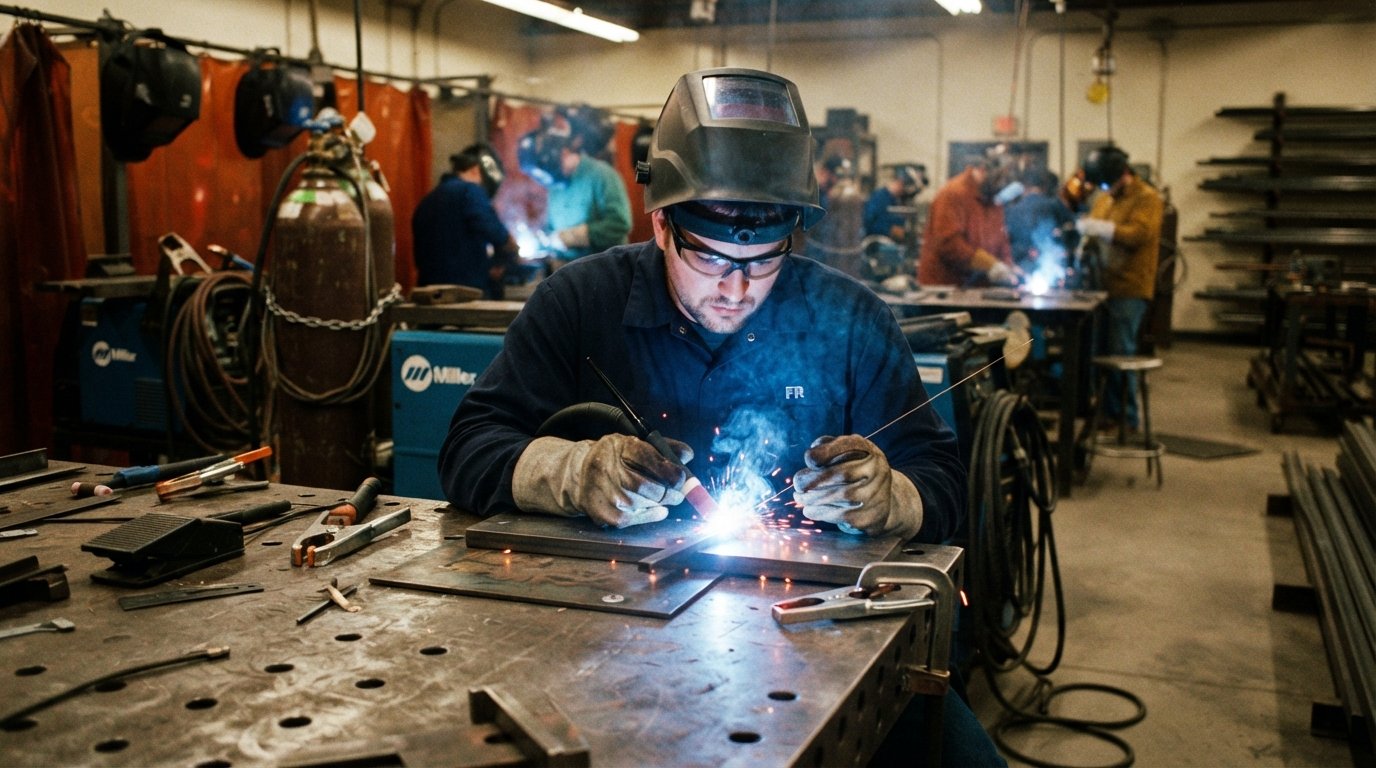
Welding Certificate in Under 12 Weeks at Allegany College
Earn a Welding Technology/Welder Certificate in under 12 weeks with hybrid in-person and online classes at Allegany College of Maryland.

By Raymond Espinoza
A welding certificate can change your career trajectory faster than almost any other credential in the skilled trades. At Allegany College of Maryland, the Welding Technology/Welder Certificate is designed to be completed in less than 12 weeks, with a mix of in-person and online coursework that fits around work and family obligations. For anyone in Cumberland, Frostburg, or the broader western Maryland and West Virginia panhandle region looking to enter a high-demand trade without spending years in a classroom, this program deserves a close look.
Welding remains one of the most portable and recession-resistant skills in the American economy. Welders build bridges, repair pipelines, fabricate custom metalwork, and keep manufacturing lines running. The Bureau of Labor Statistics projects steady demand for skilled welders through the next decade, particularly as experienced workers retire. A short-term certificate from a community college signals to employers that you have hands-on training and safety knowledge, not just theoretical interest.
What the Welding Technology/Welder Certificate Covers
The Welding Technology/Welder Certificate at Allegany College of Maryland is built around practical competencies. Students learn the major arc welding processes used across construction, manufacturing, and maintenance sectors. The curriculum typically covers shielded metal arc welding (stick), gas metal arc welding (MIG), flux-cored arc welding, gas tungsten arc welding (TIG), oxy-fuel cutting, and blueprint reading. Safety procedures, electrode selection, and weld inspection fundamentals round out the training.
Because the program blends in-person and online delivery, the lecture and theory portions can often be completed remotely, while the hands-on lab work happens on campus in a supervised shop environment. That hybrid structure is a major advantage for adult learners who cannot rearrange their entire schedule for a traditional full-time program. You still get real torch time and real metal under the hood, but you also get flexibility on the academic side.
Students who complete the certificate leave with a portfolio of welds, familiarity with industry codes and standards, and the confidence to pass entry-level weld tests. Many employers in the region use standardized tests such as those from the American Welding Society as a hiring benchmark, and the program is structured to prepare graduates for that reality. If you want to compare this program against other short-term credentials, resources like this guide to a fast online certificate can help you understand how accelerated formats work in different fields.
Why the Under-12-Week Timeline Matters
Time is the scarcest resource for most career changers. A traditional associate degree in welding takes two years. A bachelor's degree takes four. The Welding Technology/Welder Certificate compresses the core employable skills into a single academic term, which means you can be job-ready in months rather than years. That speed matters for several reasons.
- You enter the workforce sooner and start earning a paycheck while peers are still in general education courses.
- Tuition and fees are lower because you are paying for fewer credit hours and fewer semesters.
- You can test the trade before committing to a longer degree, reducing the risk of switching paths later.
- Employers in fabrication, construction, and maintenance often hire on demonstrated skill rather than degree level.
That last point is critical. In the welding trade, what you can do with a torch and a filler rod matters more than how many credits you accumulated. A certificate that gets you into the booth and produces quality welds is often more valuable to an entry-level employer than a broader degree with less shop time. The Allegany program is designed with that employer mindset in mind.
It is also worth noting that the certificate can serve as a stepping stone. Some graduates return later to pursue an associate degree or specialized certifications in pipe welding, underwater welding, or robotic welding. The short program gets your foot in the door; additional credentials can raise your ceiling over time.
In-Person and Online: How the Hybrid Format Works
The phrase "mix of in-person and online" can mean different things at different schools. At Allegany College of Maryland, the practical reality is that the hands-on welding labs must be completed in person because you cannot learn to run a bead through a video call. The online component typically covers safety modules, welding theory, blueprint interpretation, metallurgy basics, and written assignments that support the shop work.
This split is actually ideal for many students. You can review lecture material at night after work, then spend your campus hours focused entirely on torch time and instructor feedback. Instead of sitting through a two-hour lecture before touching a machine, you arrive at the lab already prepared and ready to weld. That efficiency is one reason hybrid trade programs have grown in popularity.
Prospective students should confirm the exact weekly schedule with the college before enrolling, since lab availability, cohort sizes, and term start dates can vary. Some cohorts may meet several days per week, while others may concentrate lab hours into fewer, longer sessions. The admissions office or program coordinator can clarify what a typical week looks like.
Admission Requirements and What to Expect
Community college certificate programs are generally more accessible than degree programs, but there are still steps to complete. At Allegany College of Maryland, applicants typically need to submit an application, provide proof of high school completion or equivalent, and in some cases take a placement assessment for math and reading. Because welding involves safety-sensitive work, students should also be prepared for basic physical requirements and shop safety orientation.
Financial aid may be available for eligible students, including federal grants, state workforce development funds, and scholarships through the college foundation. Short-term certificate programs sometimes qualify for workforce innovation grants or trade-specific funding, so it is worth speaking with the financial aid office even if you assume you will not qualify. The total cost of the certificate is far lower than a two-year degree, but every dollar of aid still helps.
It also helps to visit the campus and see the welding shop before committing. Talk to instructors, ask about equipment, and find out what certifications recent graduates have earned. A quick conversation can tell you more about a program than any brochure.
Career Outcomes for Certificate Holders
Welding certificate graduates find work in a surprisingly wide range of settings. Construction companies hire welders for structural steel. Manufacturing plants hire them for production fabrication. Maintenance departments at hospitals, schools, and municipalities hire them for repair work. Pipeline and energy companies hire them for field welding, often at premium pay. Some graduates eventually open their own fabrication shops or mobile welding businesses.
Entry-level wages vary by region and industry, but welding consistently pays above minimum wage and offers overtime opportunities. Welders who acquire additional certifications, such as pipe welding or AWS D1.1 structural certification, can command significantly higher rates. The certificate is a starting point, not a dead end.
For students who want to explore how short-term credentials fit into broader education and career planning, platforms like TopStudents can help you browse programs and compare options without pressure. HigherEducationAdvisor.com also maintains directories of certificate and degree programs by field and by state, which can help you see how the Allegany offering compares to alternatives in Maryland, Pennsylvania, and West Virginia.
How to Decide If This Program Is Right for You
Not everyone should enroll in a welding certificate. The trade rewards people who are comfortable working with their hands, who can tolerate heat and physical effort, and who take safety seriously. If you prefer desk work or are unwilling to get dirty, welding may not be a good fit. But if you enjoy building things, solving spatial problems, and seeing tangible results at the end of the day, it can be a highly satisfying career.
Ask yourself a few honest questions before applying:
- Can I commit to the lab schedule for the duration of the program, which is less than 12 weeks?
- Am I physically able to stand for extended periods and lift moderate weights?
- Do I have reliable transportation to campus for the in-person sessions?
- Am I willing to start at an entry-level wage and work my way up?
- Do I want a career that values skill and certification over formal degrees?
If most of your answers are yes, the Welding Technology/Welder Certificate at Allegany College of Maryland is worth a serious look. The combination of a short timeline, hybrid delivery, and hands-on training makes it one of the more practical trade credentials available in the region.
Take the next step by contacting the college directly, requesting information about start dates, and visiting the shop. A few weeks of focused effort can put you on a path to a skilled trade that will be in demand for decades.