
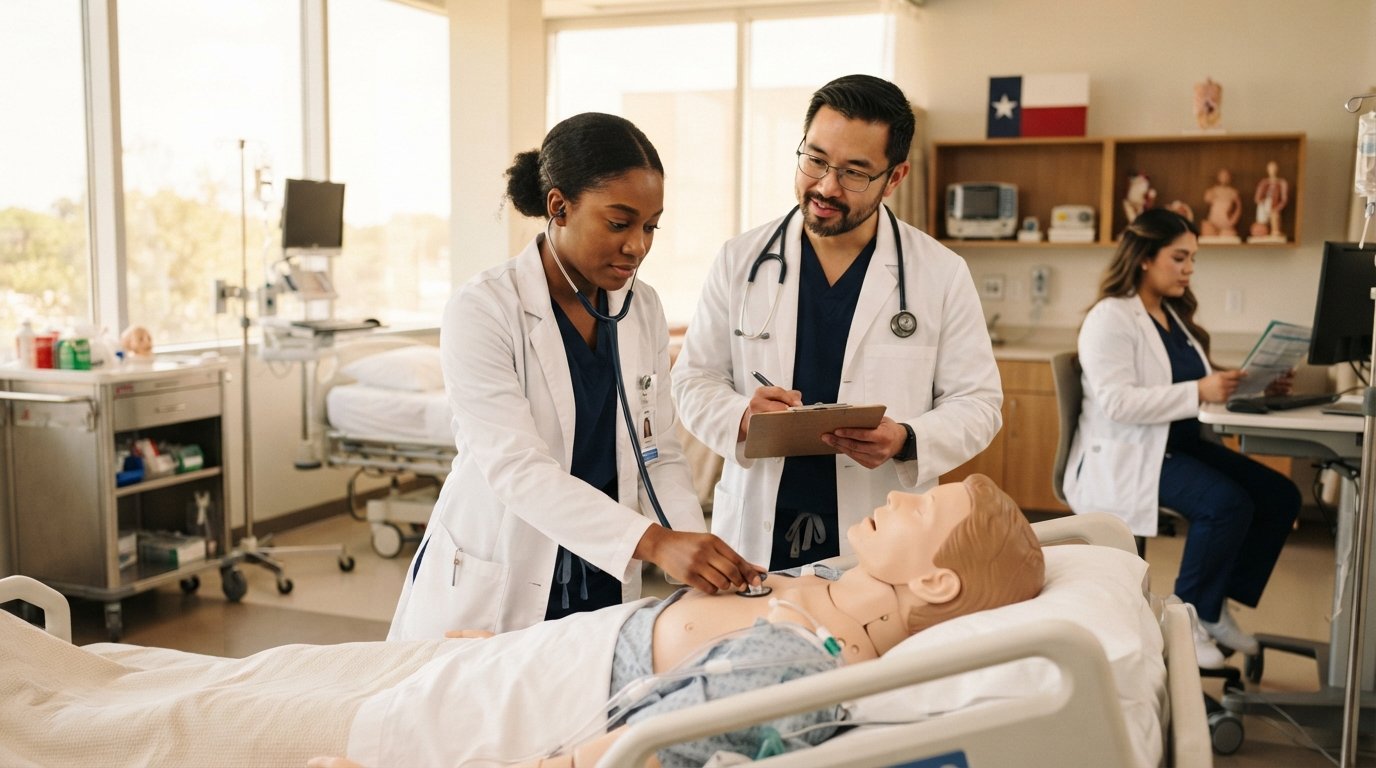
Top Nursing Programs in Texas: Online and Campus
Discover the top nursing programs in Texas online and on campus, with tips on accreditation, clinical placements, and costs.

By Leslie Wulfert
Texas is one of the strongest states in the nation for nursing careers, with a healthcare industry that keeps expanding across Houston, Dallas, San Antonio, and beyond. For anyone considering a nursing degree, the choice between online and on-campus study can feel as important as picking the right school. Online programs offer flexibility for working adults and parents, while traditional campus programs provide hands-on clinical experiences and direct faculty mentorship. The best path depends on your current obligations, your learning style, and how far you are willing to travel for clinical rotations. In this guide, we break down the top nursing programs in Texas online and on campus, what each format really delivers, and how to decide which one fits your goals.
Why Texas Is a Prime Destination for Nursing Students
Texas faces a persistent nursing shortage, and state leaders have responded with funding for faculty, simulation labs, and new program expansions. The Texas Board of Nursing reports that thousands of qualified applicants are turned away each year due to limited clinical slots, which means competition is real. However, the demand for registered nurses (RNs), nurse practitioners (NPs), and nurse educators remains so high that graduates typically find work quickly. The state also offers a relatively low cost of living compared to coastal states, which makes starting a nursing career here financially attractive.
For students, this environment creates a unique advantage: you can attend school in a state where employers are actively recruiting. Many Texas hospitals have partnered with community colleges and universities to offer tuition reimbursement, residency programs, and employment guarantees for new graduates. Whether you choose an online program with local clinical placements or an on-campus track with established hospital affiliations, the Texas healthcare network is deep and welcoming.
What to Look for in a Nursing Program
Before comparing schools, you need a clear set of criteria. Nursing programs vary widely in accreditation, NCLEX pass rates, clinical hour requirements, and total cost. The most important factor is accreditation: look for programs approved by the Texas Board of Nursing and accredited by either the Commission on Collegiate Nursing Education (CCNE) or the Accreditation Commission for Education in Nursing (ACEN). These accreditations ensure the curriculum meets professional standards and that your degree will be recognized by employers and graduate schools.
Beyond accreditation, focus on the following:
- NCLEX-RN pass rates: High pass rates (above 90%) indicate strong preparation for the licensing exam.
- Clinical placement support: Find out whether the school arranges clinical sites or if you must secure them yourself.
- Program format: Fully online, hybrid, or in-person; each has different time commitments and technical requirements.
- Total cost and financial aid: Compare tuition, fees, books, and hidden costs like simulation lab access or travel for clinicals.
- Graduation and job placement data: Ask for recent statistics to see how many students finish and find work within six months.
All of these factors matter more than the prestige of the school name. A smaller program with high pass rates and dedicated advisors may serve you better than a large university where you feel lost in the crowd. Similarly, an online program with strong clinical coordination can be just as rigorous as a traditional one, provided you are self-disciplined.
Top On-Campus Nursing Programs in Texas
If you thrive in a structured classroom environment and want direct access to professors and peers, on-campus programs remain a powerful option. Texas is home to several nationally ranked nursing schools that offer comprehensive bachelor's and graduate degrees.
The University of Texas at Austin School of Nursing consistently ranks among the top in the nation. Its Bachelor of Science in Nursing (BSN) program admits a select cohort each year, with rigorous science prerequisites and a strong focus on leadership and community health. Students complete clinical rotations at major hospitals in the Austin area, including Dell Seton Medical Center and Ascension Seton. The school also offers an accelerated BSN for second-degree students, which can be completed in about 15 months of full-time study.
Texas A&M University's College of Nursing, located in Bryan-College Station, has gained a reputation for its simulation-based curriculum and high-fidelity manikins. The BSN program emphasizes rural and underserved healthcare, which is a growing need across the state. Clinical partnerships with Baylor Scott & White and CHI St. Joseph give students real-world experience in both urban and community settings.
The University of Texas Health Science Center at Houston (UTHealth Houston) offers a traditional BSN as well as an RN-to-BSN bridge for working nurses. Its location in the Texas Medical Center, the largest medical complex in the world, is an unmatched advantage for clinical placements. Students rotate through leading institutions like MD Anderson Cancer Center, Memorial Hermann, and Children's Memorial Hermann. For graduate students, UTHealth Houston offers a Doctor of Nursing Practice (DNP) with tracks in family, psychiatric, and adult-gerontology care.
Texas Christian University (TCU) in Fort Worth is another standout, particularly for its BSN program with a strong patient-centered focus. TCU's nursing building features state-of-the-art simulation suites and dedicated skills labs. The school also offers a Christian-based mission that appeals to students seeking a values-driven education.
Each of these schools has selective admission, so plan to complete prerequisites with high grades. On-campus programs often require more scheduled hours, but they also provide the social support of study groups and faculty office hours, which can be crucial during challenging semesters.
Top Online Nursing Programs in Texas
Online nursing programs have evolved far beyond simple video lectures. Many now offer interactive simulations, virtual patient scenarios, and remote proctoring for exams. The key is finding a program that pairs online coursework with in-person clinical experiences that you can complete near your home.
The University of Texas at Arlington (UTA) is a leader in online nursing education. Its online RN-to-BSN program is one of the largest in the country, designed for working registered nurses who already hold an associate degree or diploma. The curriculum is fully online, with no campus visits required, and you can progress at your own pace. UTA also offers online graduate programs, including a Master of Science in Nursing (MSN) in nursing education and a DNP in leadership, which appeal to nurses aiming for advanced practice or administrative roles.
Texas Tech University Health Sciences Center (TTUHSC) offers an online BSN completion for RNs and a fully online MSN with tracks in family nurse practitioner (FNP), psychiatric mental health, and nursing administration. The FNP program requires clinical hours that you can schedule with preceptors in your own community, a major plus for students in rural areas. TTUHSC uses a cohort model, meaning you progress with the same group of students, which builds a strong sense of community despite the distance.
Chamberlain University, which has a large presence in Texas, offers an online BSN option for pre-licensure students. This is less common, as most online BSNs are RN-to-BSN programs. Chamberlain's hybrid model combines online courses with in-person clinicals and a few weekend immersion sessions on its Houston campus. It is a good choice for career changers who cannot relocate but still want a traditional first-degree nursing path.
Western Governors University (WGU) Texas is another competency-based option for RNs seeking a BSN or MSN. WGU allows you to move through courses as quickly as you master the material, which can save time and money. The curriculum is self-paced, and you receive a mentor who checks in weekly. While there are no scheduled classes, you must complete a capstone project and demonstrate clinical competencies through assessments.
Comparing Online and On-Campus Costs and Time
Cost and time are often the deciding factors for nursing students. On-campus programs at public universities in Texas typically charge between $8,000 and $20,000 per year for tuition and fees, depending on your residency status. Private schools like TCU or Baylor can cost $40,000 or more annually. Online programs vary widely: RN-to-BSN completion degrees at public universities may cost $10,000 to $15,000 in total, while graduate-level online programs can range from $20,000 to $60,000.
Time to completion also differs. A traditional BSN takes four years of full-time study. An accelerated BSN for students with a prior bachelor's degree can be completed in 12 to 18 months of intensive work. Online RN-to-BSN programs are often designed for part-time students and may take two to three years, though some schools allow faster completion. Graduate programs, such as an MSN or DNP, typically require two to four years beyond the BSN.
When comparing costs, remember to factor in clinical travel expenses, uniform costs, background checks, and simulation fees. Online programs may save you on commuting and parking, but they often require a reliable computer and high-speed internet. Some online programs also charge a technology fee each semester. make a spreadsheet with all these variables before you apply.
Admission Requirements and Prerequisites
Nursing schools share a common core of prerequisites, but each program has unique requirements. For a traditional BSN, you typically need a high school diploma with strong grades in biology, chemistry, and algebra. College-level prerequisites include anatomy and physiology I and II, microbiology, statistics, and psychology. Most programs require a minimum GPA of 2.75 to 3.0, though competitive schools often look for 3.5 or higher.
For RN-to-BSN programs, you need an active, unencumbered RN license and an associate degree or diploma in nursing. Some programs require a certain number of work hours as an RN. For graduate programs, you must have a BSN from an accredited program, a current RN license, and often one to two years of clinical experience. Many online MSN programs also require a statistics course and a nursing research course.
The key is to start early. If you are still in high school, take college prep courses and volunteer at a hospital or clinic. If you are a college student, meet with a pre-nursing advisor every semester to ensure you are on track. If you are a working nurse, check whether your employer offers tuition assistance or a partnership with a specific university.
Clinical Placements and Hands-On Experience
No nursing degree can be completed fully online, because clinical hours are a mandatory part of licensure. The difference lies in how schools coordinate these experiences. On-campus programs typically have contracts with local hospitals and clinics, and the school schedules your rotations for you. This is convenient, but it also means you may be placed in a facility that requires a commute. Online programs often shift the responsibility to you: you must find your own preceptors and clinical sites, though the school provides guidelines and approval processes.
For online students in Texas, this can be a challenge in rural areas where preceptors are scarce. However, many online programs now use a hybrid model where you complete some simulations virtually and then travel to a regional site for intensive weekends. For example, some FNP programs require you to attend one or two on-campus residencies per semester, where you practice skills with faculty and standardized patients.
If you are considering an online program, ask detailed questions about clinical placement support. How many students fail to find a placement? What happens if you cannot secure a site? Are there any geographic restrictions? Some online programs limit clinicals to certain states due to regulatory agreements, so verify that Texas is covered.
Licensure and the NCLEX Exam
After completing a nursing program, you must pass the NCLEX-RN to become a licensed registered nurse. The Texas Board of Nursing administers the exam and requires a criminal background check as part of the application. Your school's curriculum should be designed to prepare you for the NCLEX, and most programs report pass rates on their websites. Look for a pass rate above 90% for first-time test takers.
Online programs often integrate NCLEX preparation into their final semester, with practice exams and review courses. However, you must be self-motivated to study independently. On-campus programs may offer structured review sessions and faculty-led study groups. Either way, treat NCLEX prep as a full-time job in the month before the exam.
For advanced practice nurses, such as NPs, you will need to pass a national certification exam in your specialty area (e.g., FNP, psychiatric mental health). The Texas Board of Nursing also requires additional documentation for prescriptive authority. Graduate programs typically help you navigate this process, but you should research state regulations early.
Career Outcomes and Job Market for Texas Nurses
The job outlook for nurses in Texas is excellent. The U.S. Bureau of Labor Statistics projects that registered nursing employment will grow by 6% nationally through 2031, and Texas is expected to outpace that rate due to its growing population and aging baby boomers. Hospitals in major metros are offering sign-on bonuses and relocation packages, especially for nurses in critical care, emergency, and labor and delivery.
Salary levels vary by region and experience. According to the Texas Workforce Commission, the average annual wage for RNs in Texas is around $80,000, but this can range from $68,000 in rural areas to $95,000 in Houston or Austin. Advanced practice nurses, such as NPs, earn an average of $115,000 or more, depending on specialty. Nurse educators and administrators can see even higher figures.
When choosing a program, look at where graduates actually work. Many schools have career services that host job fairs and connect students with alumni. Online students should also leverage professional organizations, such as the Texas Nurses Association, to build a network. And remember that your first job is not the end point: many Texas hospitals offer residency programs for new grads, which provide extra training and mentorship during your first year.
How to Choose Between Online and On-Campus Nursing Programs
The decision ultimately comes down to your personal circumstances. If you are a new high school graduate who has never taken college courses, an on-campus program may be the safer bet, as it provides structure, direct faculty interaction, and a built-in peer network. If you are an adult with family or work obligations, an online program allows you to study at night and on weekends, but it requires exceptional time management and self-discipline.
You should also consider your learning style. Do you absorb information best in a lecture hall, or do you prefer watching videos and reading at your own pace? Are you comfortable approaching professors by email, or do you need face-to-face office hours? Be honest with yourself. A program that does not match your style will lead to frustration and may delay your graduation.
Another factor is your long-term career goals. If you want to become a nurse practitioner, a DNP, or a nurse educator, you will eventually need a graduate degree. Many online graduate programs are designed for working nurses who cannot pause their careers. On the other hand, if you are aiming for a leadership role in a hospital, an on-campus MSN with an internship component might provide better networking.
Regardless of the format, visit the school's website and talk to current students or alumni. Ask about their satisfaction with clinical placements, faculty responsiveness, and career services. You can also use an education matching platform like our guide on Florida business degrees as a model for comparing programs in other states, but for Texas nursing, focus on schools that are accredited and have strong ties to the local healthcare community.
Financial Aid and Scholarships for Nursing Students
Nursing school is an investment, but there are many ways to reduce the cost. The first step is to complete the Free Application for Federal Student Aid (FAFSA), which determines your eligibility for federal grants, work-study, and loans. For Texas residents, the Texas Application for State Financial Aid (TASFA) is also required for state grants if you are not eligible for federal aid.
Many schools offer their own scholarships for nursing students, based on academic merit, financial need, or diversity. For example, the UT System has the Cizik Nursing Scholarships, and the Texas Nurses Foundation provides $5,000 to $10,000 awards. The federal Nurse Corps Scholarship Program covers full tuition and fees in exchange for two years of service at a critical shortage facility. The Texas Health and Human Services Commission also offers the Nursing Shortage Reduction Program, which forgives student loans for nurses who work in underserved areas.
If you are already an RN, your employer may offer tuition reimbursement. Many Texas hospitals, such as HCA Houston Healthcare and Baylor Scott & White, have partnerships with universities to offer discounted tuition for their employees. Always check with your human resources department before applying to a program, as they may have specific requirements for reimbursement.
Accreditation and Program Approval: Less Obvious Factors
Beyond the official accreditations, you should look for program-specific approvals. For example, if you want to become a nurse practitioner, your MSN or DNP program must be approved by the Texas Board of Nursing to offer advanced practice education. Some programs may be accredited nationally but not approved in Texas, which would prevent you from sitting for the APRN exam in the state.
Also, check whether the program has any probationary status. The Texas Board of Nursing publishes a list of programs that have been issued warnings or have failed to meet minimum NCLEX pass rates. Avoid these programs, as they may lose their approval and you could be left without a degree that qualifies for licensure.
Finally, consider the school's reputation with employers. While a degree from any accredited program is valid, some hospitals prefer graduates from specific universities. This is not always fair, but it is a reality. Ask local nurse managers where they hire from, and let that inform your decision.
Building a Strong Application
Nursing programs, especially top ones, are competitive. To stand out, you need more than a high GPA. Here are practical steps to strengthen your application:
- Gain healthcare experience: Volunteer at a hospital, shadow a nurse, or become a certified nursing assistant (CNA). This shows commitment and gives you a taste of the profession.
- Get strong recommendation letters: Ask professors, employers, or volunteer supervisors who know you well. A generic letter is less effective than one that speaks to your character and work ethic.
- Write a compelling personal statement: Explain why you want to be a nurse, what experiences have shaped your decision, and how this specific program fits your goals.
- Prepare for interviews: Many programs require an interview, which may be online. Practice answering behavioral questions, such as how you handle stress or conflict.
- Apply early: Deadlines are often months before the start date. Submit your application and all supporting documents well in advance.
If you are not accepted the first time, do not give up. Many students apply two or three times before they get in. Use the extra year to strengthen your GPA, gain more experience, and reapply with a better package.
Using HigherEducationAdvisor to Compare Schools
As you narrow down your list of top nursing programs in Texas online and on campus, take advantage of free resources that help you compare schools side by side. HigherEducationAdvisor.com is a free education matching service that lets you explore programs by field and location. You can request information from participating schools without any obligation to apply or enroll, which is a great way to get detailed brochures and talk to admissions advisors.
One of the best tools is the program matching tool at HigherEducationAdvisor.com. You answer a few questions about your desired degree level and field, and the site generates a list of sponsored programs that might fit your needs. This is not a college or university, so it does not grant credit or admissions decisions. Instead, it acts as a referral service, connecting you with schools that are actively recruiting. You can also browse schools by state, which is useful if you are only considering Texas institutions.
Another useful approach is to visit the college directory and filter by Texas. This gives you a comprehensive view of which schools offer nursing programs and how to contact them. You can then visit each school's official website to verify accreditation, clinical placement policies, and NCLEX pass rates. By using a mix of independent research and referral services, you ensure you have all the facts before making a decision.
Finally, for those considering out-of-state options or comparing different fields, the site's blog offers detailed guides on various degree paths. While the focus is on Texas nursing, you can apply the same criteria to any program.
In summary, the top nursing programs in Texas online and on campus are within reach if you do your homework. Determine your ideal format, check accreditation and pass rates, and compare costs carefully. Whether you choose the vibrant campus of UT Austin, the flexible online platform of UTA, or the clinical prestige of UTHealth Houston, your nursing career starts with a solid educational foundation. Take the next step today by requesting information from a few schools and seeing which one feels like the right fit. TopStudents