
Teacher Certification vs Education Degree: Key Differences
Teacher certification vs education degree what's the difference? One is a state license, the other an academic award. Call 8772187081 for guidance.

By Leslie Wulfert
You have probably seen job postings that ask for a teaching certificate, while others request a degree in education. The two terms get used interchangeably in casual conversation, but they describe very different things. One is a professional credential issued by a state agency that gives you legal permission to teach in public schools. The other is an academic award granted by a college or university after you complete a program of study. Understanding this distinction matters whether you are a high school student mapping out a four-year plan, a career changer weighing a fast-track license, or a current teacher thinking about a master's degree. Getting it wrong can cost you time, tuition money, and job opportunities.
This guide breaks down teacher certification vs education degree what's the difference really means in practice. You will see how each path works, which one employers and state boards actually require, how the routes overlap, and how to choose the option that fits your goals and your budget.
What an Education Degree Actually Is
An education degree is an academic credential. It is awarded by a college or university after you complete a set number of credits in a structured program. Common examples include a Bachelor of Arts in Elementary Education, a Bachelor of Science in Special Education, or a Master of Education in Curriculum and Instruction. The degree proves you completed coursework in subjects like child development, learning theory, assessment design, classroom management, and educational psychology. It also usually includes a supervised student teaching component, which is the closest thing to on-the-job training you will get before running your own classroom.
Degrees come in several levels. An associate degree in education, often earned at a community college, can prepare you for roles as a teaching assistant or paraeducator. A bachelor's degree is the standard entry point for most licensed teaching positions. A master's degree can deepen your expertise, open doors to administrative roles, or satisfy continuing education requirements for experienced teachers. Some educators even pursue doctoral degrees for research, policy, or university-level teaching careers.
Here is the key point: a degree is evidence of learning. It says you completed a program and met its academic standards. It does not, by itself, give you permission to teach in a public school classroom. That permission comes from the state, and it comes in the form of certification or licensure.
It is also worth noting that not every education degree leads to a classroom. If you are curious about the broader range of options, including instructional design, corporate training, museum education, and policy work, you can explore career paths with an education degree not teaching to see how versatile the credential can be.
What Teacher Certification Really Means
Teacher certification, sometimes called licensure, is a government-issued credential. It is granted by a state department of education or a similar regulatory body. When you hold a valid teaching certificate, the state is confirming that you have met its specific requirements to work as a teacher in publicly funded schools. Those requirements typically include a bachelor's degree, completion of an approved teacher preparation program, passing scores on standardized exams, a background check, and sometimes additional coursework in areas like reading instruction or special education.
The word certification and the word licensure are often used interchangeably, though some states draw a technical distinction. In most cases, both refer to the legal authorization to teach. Without it, you generally cannot be hired as a full-time teacher in a public school district, no matter how many degrees you hold.
Certification is also specific. It usually names the grade levels and subject areas you are approved to teach. For example, you might hold an elementary certificate for grades K through 6, or a secondary certificate in biology for grades 7 through 12. If you want to teach a different subject or age group, you often need to add an endorsement or earn a new certificate. This specificity is one reason certification requirements vary so much from state to state.
Some states offer alternative certification pathways for career changers and professionals who already hold a bachelor's degree in a non-education field. These programs can be faster and more flexible than traditional routes, but they still lead to the same end goal: a state-issued certificate that allows you to teach.
Teacher Certification vs Education Degree: The Core Differences
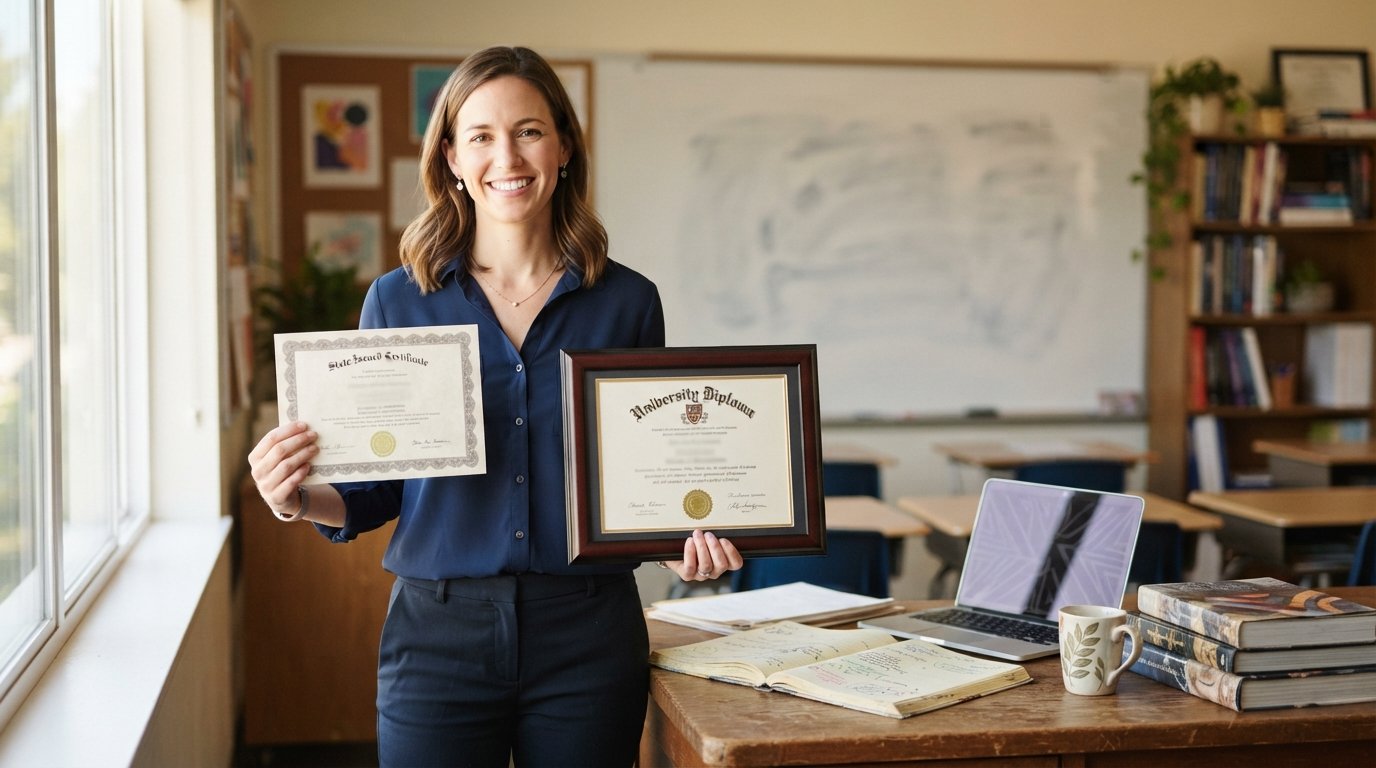
When people ask about teacher certification vs education degree what's the difference, they are usually trying to figure out which one they need. The short answer is that they serve different purposes, and in most public school teaching careers, you need both. A degree demonstrates your academic preparation. A certificate grants you legal permission to teach. One is issued by a college or university. The other is issued by a state agency.
The table below summarizes the main distinctions, but the paragraphs that follow explain why each difference matters for your planning.
- Issuing body: A degree comes from an accredited college or university; a certificate comes from a state education agency.
- Purpose: A degree proves you completed a program of study; a certificate proves you are legally authorized to teach.
- Requirements: A degree requires coursework and credits; a certificate requires a degree plus exams, background checks, and sometimes additional training.
- Portability: Degrees are generally recognized nationwide; certificates are state-specific and often require reciprocity agreements to transfer.
- Renewal: Degrees do not expire; certificates usually require renewal every few years through continuing education or professional development.
The portability difference catches many teachers off guard. If you earn a teaching certificate in one state and then move to another, you cannot simply start teaching. You must apply for certification in your new state, and your eligibility depends on whether the two states have a reciprocity agreement. Even then, you may need to complete additional coursework or exams. A degree, by contrast, travels with you because regional accreditors recognize each other's standards.
The renewal difference also matters for long-term planning. A bachelor's degree is yours forever. A teaching certificate typically expires after a set number of years, and you must complete professional development hours or additional coursework to keep it active. Some states require a master's degree to move from an initial certificate to a professional or continuing certificate, which is one reason many teachers pursue graduate education later in their careers.
Do You Need a Degree to Get Certified?
In almost every state, yes. A bachelor's degree is the foundational requirement for initial teacher certification. However, the degree does not always have to be in education. Many states allow you to earn a bachelor's degree in a subject like mathematics, history, or biology, then complete a post-baccalaureate teacher preparation program to earn your certificate. This route is common among career changers who already hold a degree in another field.
That said, some pathways are more direct than others. If you know early that you want to teach, an education degree that includes a state-approved preparation program can streamline the process. You complete your coursework and your student teaching in one coherent package, and your program director usually helps you navigate the certification application. If you discover teaching later, an alternative certification program can get you into the classroom faster, though you may need to complete additional coursework while you teach.
Requirements also vary by grade level and subject. Elementary teachers often need a broad foundation in multiple subjects, while secondary teachers usually specialize in one or two content areas. Special education teachers may need additional certifications or endorsements. English as a Second Language (ESL) teachers often need specialized training. Each of these variations affects which degree and which certificate you should pursue.
How the Two Paths Overlap in Practice
In a traditional teacher preparation program, the degree and the certificate are woven together. You declare an education major, complete the required courses, pass your state exams, finish student teaching, and apply for certification. The university may even recommend you for certification directly, which simplifies the application. In this model, the degree is the vehicle and the certificate is the destination.
Alternative routes separate the two more clearly. You might already hold a bachelor's degree in English, for example, and then enroll in a one-year certification program that includes pedagogy courses and a supervised teaching internship. You earn the certificate without earning a second degree. Later, if you want to advance your career or meet state requirements for a professional certificate, you might return to school for a master's degree.
Online programs have made both paths more accessible. Many accredited universities offer online education degrees and online teacher certification programs, which is helpful if you live in a rural area, work full time, or need flexibility for family reasons. When comparing online options, check that the program is accredited and that it leads to certification in your state, because not all online programs meet every state's requirements.
If you are still exploring which programs might fit your situation, a matching service like TopStudents.com can help you browse online and on-campus degree programs, compare sponsored school listings, and request information from schools that align with your goals, with no obligation to apply or enroll.
Which One Should You Pursue First?
For most aspiring public school teachers, the answer is both, and the order depends on where you are starting. If you are a high school student or a first-year college student, a bachelor's degree in education (or a bachelor's degree plus a teacher preparation program) is the natural first step. That program will position you to apply for certification upon graduation. If you already hold a bachelor's degree in another field, an alternative certification program may be your fastest route into the classroom, and you can pursue a master's degree later if you choose.
If you are not sure whether you want to teach in a public school, a private school, a charter school, or a non-traditional setting, keep in mind that certification requirements differ. Private schools often do not require state certification, though they may prefer it. Charter schools vary widely. International schools may require a teaching credential from your home country. Tutoring, corporate training, and museum education roles may value a degree more than a certificate. Knowing your target setting helps you decide which credential to prioritize.
Cost and time are also factors. A traditional four-year education degree is a significant investment, but it is the most straightforward path to certification for traditional students. Alternative certification programs can be faster and less expensive, but they may require you to balance teaching responsibilities with coursework. A master's degree can increase your salary and open leadership roles, but it is usually not necessary for entry-level teaching unless your state requires it for a professional certificate.
Common Myths and Misunderstandings
One persistent myth is that a degree in education automatically makes you a certified teacher. It does not. You still need to meet your state's certification requirements, which may include exams, background checks, and a formal application. Another myth is that certification alone is enough to teach at any level. In reality, certificates are specific to grade levels and subjects, and you may need additional endorsements to teach outside your original area.
A third misunderstanding involves reciprocity. Many people assume that a teaching certificate from one state works in every other state. While many states have reciprocity agreements, they are not universal, and even within agreements, you may need to complete additional requirements. Always check with the receiving state's department of education before assuming your certificate will transfer.
Finally, some people believe that a master's degree is required for all teaching positions. It is not, but it is increasingly common for teachers to earn a master's degree at some point in their careers, either to meet state requirements for a professional certificate, to increase their salary, or to specialize in an area like literacy, special education, or educational leadership.
Steps to Take If You Are Deciding Between the Two
If you are still weighing your options, a structured approach can help you make a confident decision. Start by clarifying your goal: do you want to teach in a public school, or are you open to other settings? Then research your state's requirements, because they will determine which credential you need and in what order. From there, compare programs and costs, and consider whether you want to earn a degree and certification together or separately.
- Identify your target teaching role: grade level, subject, and school type.
- Review your state's certification requirements: exams, coursework, and background checks.
- Compare degree and certification programs: traditional, alternative, and online options.
- Check accreditation and state approval: make sure the program leads to certification where you plan to teach.
- Request information from schools: ask about timelines, costs, and job placement support.
After you complete these steps, you will have a clearer picture of whether you need a degree, a certificate, or both, and which program format fits your life. Remember that requirements can change, so confirm details with your state department of education and with the specific programs you are considering.
How HigherEducationAdvisor.com Can Help
HigherEducationAdvisor.com is an education matching site that helps prospective students compare sponsored online and on-campus degree and certificate programs. It is not a college and does not grant credit or degrees. Instead, it publishes guides and listings so you can explore fields of study, browse schools by state, and request information from participating institutions that may fit your goals. There is no obligation to apply or enroll, and you can use the site to gather details before making any commitment.
If you are trying to sort out teacher certification vs education degree what's the difference for your own situation, the site's program-matching tools and state directories can help you see what options exist and how they align with your plans. You can compare program levels, fields of study, and formats, then reach out directly to schools for specifics on admission, cost, and certification outcomes. Always confirm program details, including whether a program leads to certification in your state, with the school itself.
Choosing between a teacher certification and an education degree is not really an either-or decision for most future teachers. The degree builds your knowledge and qualifies you for advanced study, while the certificate gives you the legal green light to lead a classroom. Understanding how they differ, how they connect, and what your state expects will save you time and help you move toward the career you want with fewer surprises along the way.