
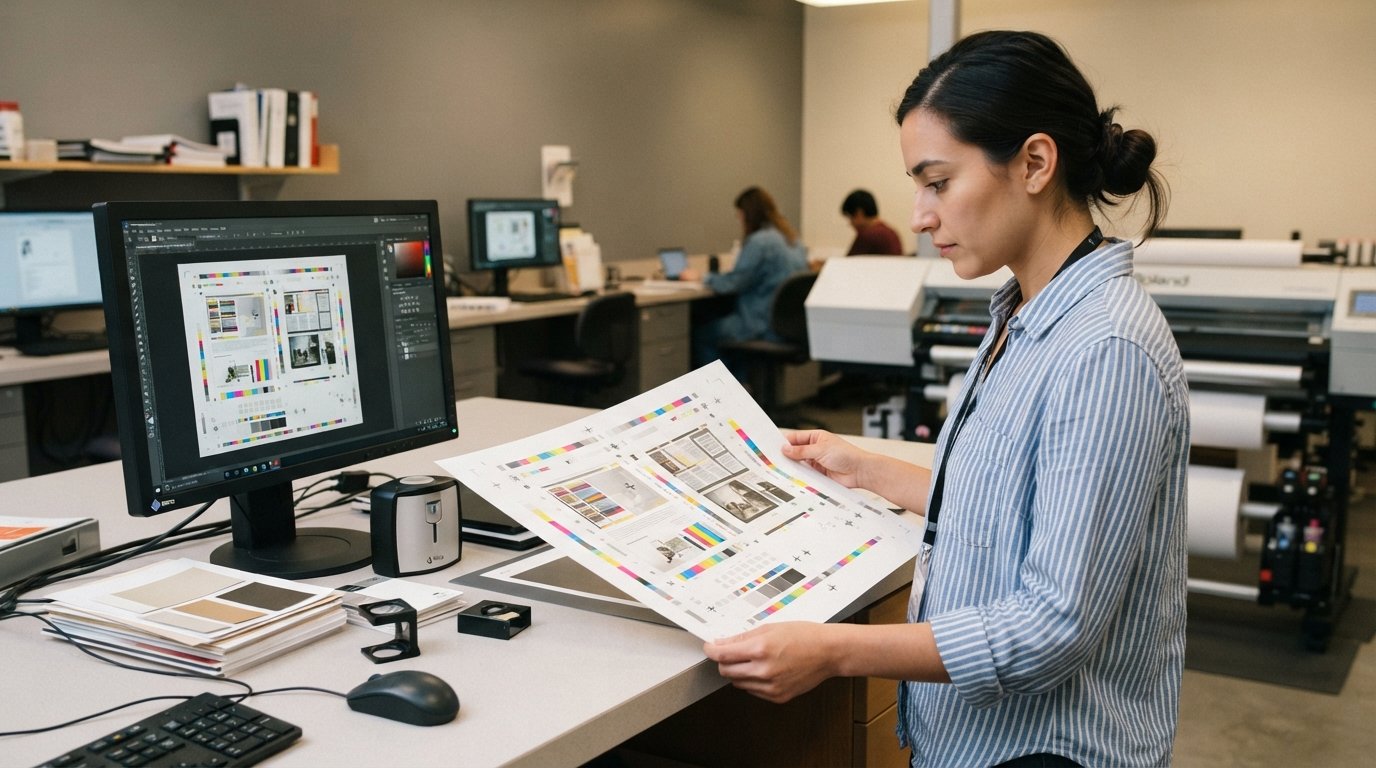
Prepress Certificate at Dodge City Community College
The Prepress/Desktop Publishing and Digital Imaging Design Certificate at Dodge City Community College trains you for print production jobs in under two years.

By Leslie Wulfert
Print is not dead. It evolved, and the professionals who prepare files for commercial presses, wide-format printers, and digital output devices are in steady demand across Kansas and the broader Midwest. If you have ever wondered how a design on a screen becomes a crisp brochure, a vehicle wrap, or a packaged label, the answer sits in the prepress stage, where technicians catch color problems, fix resolution issues, and build files that machines can actually run. The Prepress/Desktop Publishing and Digital Imaging Design Certificate, 1 year to less than 2 years In-person at Dodge City Community College is a focused, hands-on pathway into that work, and it can be completed in roughly two to four semesters of full-time study.
Dodge City Community College (DCCC) sits in southwest Kansas, and its career and technical programs are built around regional workforce needs. That matters for prospective students because a certificate is only as valuable as the employers who recognize it. In this case, the program maps to real jobs in printing companies, marketing departments, sign shops, newspaper production rooms, and in-house graphics teams. You are not chasing an abstract credential; you are training for a specific seat in a production environment.
What the Prepress Certificate Covers
Prepress is the bridge between creative design and manufacturing. A designer works in layers, effects, and untamed fonts. A press operator needs a file with correct color separations, proper bleed, embedded images, and predictable output. The certificate program lives in that middle space, teaching you the technical literacy that both sides depend on.
At DCCC, the curriculum typically blends desktop publishing software instruction with digital imaging and production workflow courses. You can expect to spend significant time in Adobe applications, particularly InDesign for page layout, Photoshop for image editing, and Illustrator for vector graphics. Those three programs form the backbone of most prepress departments, and fluency in them is the single most transferable skill you will take from the program.
Beyond software, the coursework addresses the physical realities of print. That includes understanding paper stocks, ink behavior, color management systems, imposition, trapping, and file output formats such as PDF/X. These topics sound technical because they are, but they are also the exact reasons employers hire trained prepress staff instead of assuming any designer can handle production.
- Page layout and typography using industry-standard publishing software
- Digital image editing, retouching, and resolution management
- Color theory and color management for print and digital output
- Preflight, file preparation, and output troubleshooting
- Introduction to printing processes and production workflows
Because the program is delivered in person, you get access to lab equipment, instructor feedback in real time, and the kind of troubleshooting practice that is hard to replicate online. When a file fails to output correctly, having a person beside you who can walk through the error is genuinely valuable. That hands-on format is one reason the keyword phrase emphasizes "In-person at Dodge City Community College."
Program Length, Format, and Scheduling Realities
The certificate is classified as a 1 year to less than 2 years program, which places it in the middle ground between a short-term certificate and a full associate degree. In practice, that means a committed full-time student can finish in two or three semesters, while a working adult taking evening or part-time courses might stretch it closer to two years. The flexibility is one of the program's quieter advantages.
In-person delivery does come with trade-offs. You need to be near Dodge City or willing to commute, and you need to organize your schedule around campus lab hours. For students in southwest Kansas, that is usually manageable. For anyone farther away, it is worth comparing this option against hybrid or fully online alternatives before committing. If you want to see how a hybrid digital design certificate is structured elsewhere, the Digital Design Certificate: Hybrid Program at Digital Workshop Center offers a useful point of comparison for format and pacing.
It also helps to think about what "certificate" means in the job market. A certificate is not a degree, and it will not substitute for a bachelor's in graphic design if you eventually want to lead a creative department. What it does do, very effectively, is qualify you for production-level roles and give you a credential that signals technical competence. Many students use it as a fast on-ramp to employment, then pursue further education later if their goals expand.
Admissions, Costs, and Financial Considerations
Community college certificate programs generally have accessible admissions requirements. At DCCC, you should expect to complete an application, provide proof of high school completion or equivalency, and possibly take placement assessments in reading, writing, or math. Specific requirements change from year to year, so confirm current details directly with the college before you plan your start date.
Cost is one of the strongest arguments for this route. Community college tuition per credit hour is dramatically lower than at four-year institutions, and a certificate requires far fewer credits than a degree. That combination keeps total program cost modest, especially for Kansas residents. Financial aid, scholarships, and workforce development funding may also apply, particularly for students entering high-demand technical fields.
Before enrolling, it is worth asking a few practical questions:
- What is the total credit count, and how many semesters does it take at my intended pace?
- Are lab fees, software licenses, or equipment costs separate from tuition?
- Does the program include an internship, portfolio course, or job placement support?
- Which local employers have hired recent graduates from this certificate?
Those four questions will tell you more about real value than any brochure. A certificate with strong employer relationships and a portfolio requirement is worth considerably more than one that ends with a final exam and nothing to show.
Career Outcomes and the Local Job Market
Prepress and digital imaging skills feed into a wider range of jobs than most people assume. Commercial printing is the obvious destination, but the same abilities apply in packaging, promotional products, apparel decoration, signage, and even digital marketing production. Employers in these areas need people who can take a file and make it ready for output without supervision, and that is precisely what this certificate trains you to do.
Typical entry-level job titles include prepress technician, production artist, digital imaging specialist, desktop publisher, and print production assistant. Pay varies by employer, region, and experience, and it is always wise to verify current wage data with the college, state labor resources, or actual job postings rather than relying on general figures. In smaller markets like southwest Kansas, versatility matters: the person who can also handle basic design, customer proofs, or equipment maintenance tends to advance faster.
It is also fair to acknowledge that print production has consolidated over the years. Fewer, larger shops handle more volume, and those shops demand higher technical skill. That trend actually favors trained prepress workers, because the remaining roles are less about feeding paper and more about solving complex file and color problems. The certificate positions you for that higher-skill version of the job.
How This Certificate Fits Into a Longer Education Plan
One of the smartest ways to use a prepress certificate is as a stepping stone. Many of the credits you earn may transfer into an associate degree in graphic design, printing technology, or a related field at DCCC or another institution. That means you can enter the workforce quickly, earn while you learn, and continue your education without starting over.
For career changers, the certificate is especially practical. If you are coming from retail, administrative work, or a manufacturing job, you likely already have the reliability, deadline discipline, and attention to detail that production environments reward. What you lack is the software fluency and technical vocabulary, and that is exactly what a one-year to two-year program supplies.
If you are still weighing options across fields, taking time to compare programs by subject and format can clarify your direction. Platforms such as TopStudents let prospective students browse online and on-campus programs, compare sponsored school listings, and request information without any obligation to apply or enroll. That kind of low-pressure research is a sensible first step before you commit to a specific certificate, especially if you are deciding between print production, web design, or broader digital media work.
Is This Program Right for You?
The Prepress/Desktop Publishing and Digital Imaging Design Certificate, 1 year to less than 2 years In-person at Dodge City Community College suits a particular kind of student. You will do well here if you like detail-oriented work, enjoy troubleshooting, and want a concrete skill set rather than a broad academic foundation. You should also be comfortable with computers and willing to spend long stretches in front of design software refining files until they are correct.
It is less suited to someone who wants a fully remote program, who is seeking a design-focused creative career with heavy emphasis on illustration or branding strategy, or who needs a bachelor's degree for their target employer. In those cases, a different program type or a four-year degree may be the better fit. Honest self-assessment at this stage saves both time and money.
If the fit is right, the path is straightforward: contact DCCC admissions, confirm current program requirements and costs, visit the campus if possible, and speak with an instructor about where recent graduates have landed. Those conversations will give you a realistic picture of what the certificate can do for your career.
A prepress certificate will not make you famous, and it will not replace a full design education. What it will do is make you employable in a field that quietly underpins almost every industry, from publishing to retail to manufacturing. For students in southwest Kansas who want a practical, affordable, in-person credential they can finish in under two years, this program is a genuinely solid place to start.