
Phlebotomy Certificate in Under 12 Weeks at Delgado
Delgado Community College offers a Phlebotomy Technician/Phlebotomist Certificate, less than 12 weeks In-person, preparing you for a fast entry into healthcare.

By Margaret Reis
Finding a healthcare career that gets you working with patients quickly, without spending years in a classroom, can feel like searching for a needle in a haystack. For many people in Louisiana, the answer is closer than they think. Delgado Community College offers a Phlebotomy Technician/Phlebotomist Certificate, less than 12 weeks In-person at Delgado Community College, giving students a fast, hands-on path into the healthcare field. This program is designed for people who want practical skills, direct patient contact, and a credential they can use to pursue entry-level jobs in hospitals, clinics, labs, and blood donation centers.
If you have been comparing short-term healthcare training options, this guide breaks down what the program covers, who it is for, what to expect during those weeks, and how to decide whether it fits your goals. We will also look at career outlook, certification details, and the practical steps to enroll. By the end, you should have a clear picture of whether this phlebotomy certificate is the right next move for you.
What Is a Phlebotomy Technician Certificate?
A phlebotomy technician certificate is a focused credential that trains you to draw blood safely and effectively. Phlebotomists work directly with patients, collecting blood samples for tests, transfusions, donations, and research. Unlike longer degree programs, a certificate program zeroes in on the specific skills you need to perform venipunctures (drawing blood from a vein) and capillary punctures (finger or heel sticks), along with the safety protocols that protect both you and the patient.
At Delgado Community College, the Phlebotomy Technician/Phlebotomist Certificate is delivered in person and can be completed in less than 12 weeks. That compressed timeline is one of its biggest advantages. Instead of stretching coursework over a year or more, you move through the material intensively, which means you can enter the job market faster. The in-person format also means you get hands-on practice with real equipment and supervised draws, which is critical in a field where technique matters.
This program is not a degree. It is a certificate, which means it is shorter and more targeted than an associate degree. For people who already know they want to work in healthcare but do not want to commit to a two-year program, this is a practical alternative. It also serves as a stepping stone: some phlebotomists later pursue further training to become medical assistants, lab technicians, or nurses. If you are exploring other short-term trade and technical options, you might also look at programs like the Collision Repair Technician Certificate at Baton Rouge Community College to compare how different vocational paths are structured.
Why Choose Delgado Community College for Phlebotomy Training?
Delgado Community College is a well-established institution in New Orleans with a strong reputation for workforce training. Its healthcare programs are designed with input from local employers, which means the skills you learn are the ones hiring managers actually look for. The phlebotomy certificate is no exception. The curriculum balances classroom instruction with clinical practice, so you are not just memorizing facts; you are building muscle memory for the procedures you will perform on the job.
Another advantage is the in-person format. While online programs work well for some subjects, phlebotomy is a hands-on skill. You need to practice on real or simulated arms, learn how to handle needles and tubes, and get feedback on your technique. Delgado's in-person delivery ensures you get that supervised experience. The program also prepares you for national certification exams, which many employers require or prefer.
Location matters too. If you live in or near New Orleans, Delgado is convenient. You avoid the cost and disruption of relocating for training. The college also has support services for students, including advising and financial aid guidance, which can make the enrollment process smoother. For adult learners and career changers, that support can be the difference between starting and actually finishing.
Program Format and Schedule
The program is intensive by design. Because it is completed in less than 12 weeks, you should expect a full schedule. Classes typically meet multiple days per week, and clinical hours may be scheduled during the day. This is not a program you can easily do while working a full-time job, though some students manage with evening or part-time work. Before enrolling, review the specific schedule for your cohort and plan your commitments accordingly.
You will also need to meet certain health and safety requirements, such as immunizations and background checks, before you can participate in clinical rotations. These are standard in healthcare training and are not unique to Delgado, but they do take time to complete. Start gathering your documents early so you do not miss your start date.
What You Will Learn in Less Than 12 Weeks
The curriculum is built around the core competencies that phlebotomists need on day one. You will learn anatomy and physiology as it relates to blood collection, including the circulatory system and the locations of common veins. You will study infection control, safety procedures, and the proper handling of specimens. You will also learn about the different types of blood tests and how to label, store, and transport samples correctly.
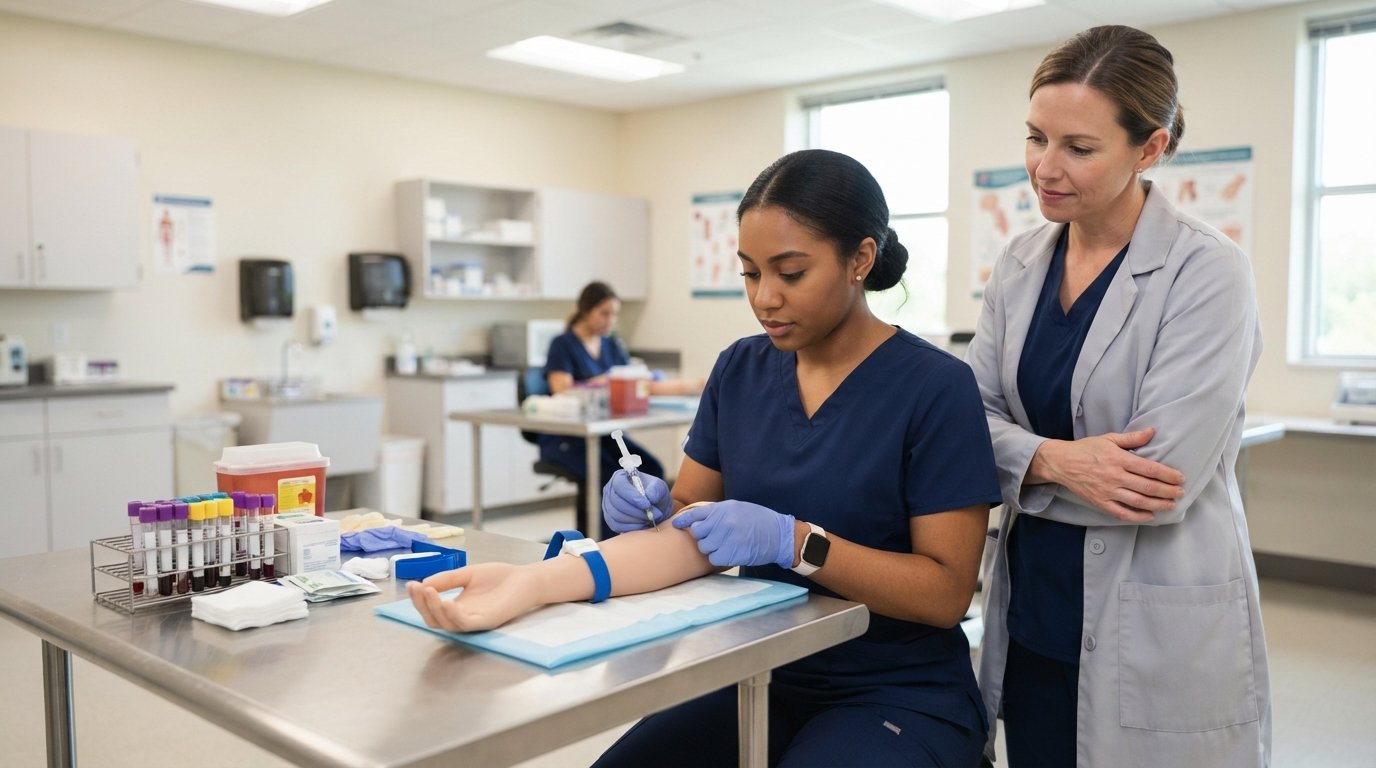
Hands-on practice is central. You will perform venipunctures and capillary punctures under supervision, using techniques that minimize patient discomfort and reduce the risk of complications. You will also learn how to interact with patients who are anxious, difficult to draw from, or have special needs. Communication skills are part of the training because phlebotomists often serve as the first point of contact for patients who are already stressed about their health.
Here is a snapshot of the key skills and knowledge areas covered:
- Venipuncture and capillary puncture techniques
- Anatomy of the circulatory system and vein selection
- Infection control, sterile technique, and safety protocols
- Specimen collection, labeling, and processing
- Patient communication and handling difficult draws
By the end of the program, you should be able to perform blood draws with confidence and understand the workflow of a clinical laboratory or collection site. You will also be prepared to sit for national certification exams, which we will discuss next.
Certification and Career Outlook
After completing the certificate, many graduates pursue national certification through organizations such as the American Society for Clinical Pathology (ASCP) or the National Healthcareer Association (NHA). Certification is not always required by law, but it is highly valued by employers and can improve your job prospects and earning potential. Delgado's program is designed to prepare you for these exams, covering the material you need to know.
The job outlook for phlebotomists is positive. According to the U.S. Bureau of Labor Statistics, employment of phlebotomists is projected to grow faster than the average for all occupations, driven by the increasing demand for diagnostic testing and preventive care. Hospitals, medical clinics, blood donation centers, and diagnostic laboratories all employ phlebotomists. In Louisiana and across the country, healthcare facilities consistently need skilled phlebotomists.
Entry-level pay varies by location and employer, but phlebotomists generally earn a competitive wage for a role that requires less than a year of training. Many employers offer benefits, shift differentials, and opportunities for advancement. Some phlebotomists move into supervisory roles, while others use the credential as a foundation for further healthcare education. If you are considering a broader range of programs, exploring options through a college matching site like TopStudents can help you compare what is available in your area.
Where Phlebotomists Work
Phlebotomists work in a variety of settings. Hospitals are the largest employer, but you can also find positions in outpatient clinics, physician offices, nursing homes, blood banks, and reference laboratories. Some phlebotomists work in mobile collection units, traveling to patients who cannot come to a facility. The variety of settings means you can often find a work environment that fits your preferences, whether you prefer the fast pace of a hospital or the more predictable schedule of a clinic.
Shift work is common, especially in hospital settings. You may work evenings, weekends, or holidays, particularly if you are new to the field. On the plus side, many healthcare roles offer flexible scheduling, and phlebotomy can be a good fit for people who want to work part-time or pick up shifts around other commitments.
Admission Requirements and Enrollment Steps
Admission to the phlebotomy certificate program at Delgado typically requires a high school diploma or equivalent. You may also need to take a placement test or meet certain prerequisite requirements, depending on the program. Because the program is in-person and includes clinical components, you will need to complete a background check, drug screening, and provide proof of immunizations. These steps are standard for healthcare programs and are designed to protect both students and patients.
The enrollment process generally follows a sequence. Here is a simplified overview of the steps you can expect:
- Apply to Delgado Community College and submit official transcripts.
- Meet with an advisor to confirm program requirements and schedule.
- Complete health and safety requirements, including immunizations and background checks.
- Register for classes and pay tuition or set up a payment plan.
- Attend orientation and begin coursework.
Because the program is short and cohorts may fill quickly, it is smart to start the process early. Contact the college's admissions office or healthcare program advisor to get the most current information on deadlines, costs, and availability. Financial aid may be available for eligible students, so ask about options when you apply.
Is This Program Right for You?
The Phlebotomy Technician/Phlebotomist Certificate, less than 12 weeks In-person at Delgado Community College is a strong fit for people who want to enter healthcare quickly, enjoy working with people, and are comfortable with hands-on procedures. It is also a good option for career changers who want a stable, in-demand job without a long educational commitment. If you are squeamish about blood or needles, this may not be the right path, but many people find that they adapt quickly once they start training.
Before you enroll, consider your schedule and your goals. The program is intensive, so you will need to dedicate significant time to classes and clinical practice. If you can manage that commitment, you could be job-ready in less than three months. That is a fast return on your investment compared to longer degree programs.
It also helps to think about where you want to work after graduation. If you plan to stay in the New Orleans area, Delgado's local reputation and employer connections can be an advantage. If you plan to move, national certification will make your credential portable. Either way, the skills you learn are in demand across the healthcare industry.
Taking the first step can feel daunting, but short-term certificate programs are designed to make the transition manageable. With in-person training, a compressed timeline, and a clear path to certification, this phlebotomy program offers a practical way to launch a healthcare career. If you are ready to stop researching and start training, reach out to Delgado Community College to learn more about the next cohort and how to apply.