
Machine Shop Certificate at Catawba Valley CC: 1-Year Path
The Machine Shop Technology/Assistant Certificate at Catawba Valley CC is a 1-2 year in-person program that builds hands-on skills for entry-level machining jobs.

By Raymond Espinoza
Skilled machinists are the backbone of modern manufacturing, turning raw metal into precision parts that power everything from medical devices to aerospace components. If you are looking for a fast, hands-on route into this high-demand field, the Machine Shop Technology/Assistant Certificate, 1 year to less than 2 years In-person at Catawba Valley Community College offers a focused pathway to job-ready skills without committing to a full degree. This program blends classroom theory with extensive shop floor practice, preparing you for entry-level roles in a region where advanced manufacturing continues to expand.
Unlike generic online courses, this certificate demands in-person attendance because machining is a tactile trade: you learn by feeling the cut, hearing the spindle, and measuring real parts. That hands-on intensity is exactly why employers trust graduates from programs like this one. In the sections below, we break down what the certificate covers, who it suits, how to enroll, and what career outcomes you can reasonably expect. Whether you are a recent high school graduate, a career changer, or someone looking to upskill, this guide will help you decide if this program is the right fit.
What the Machine Shop Technology/Assistant Certificate Covers
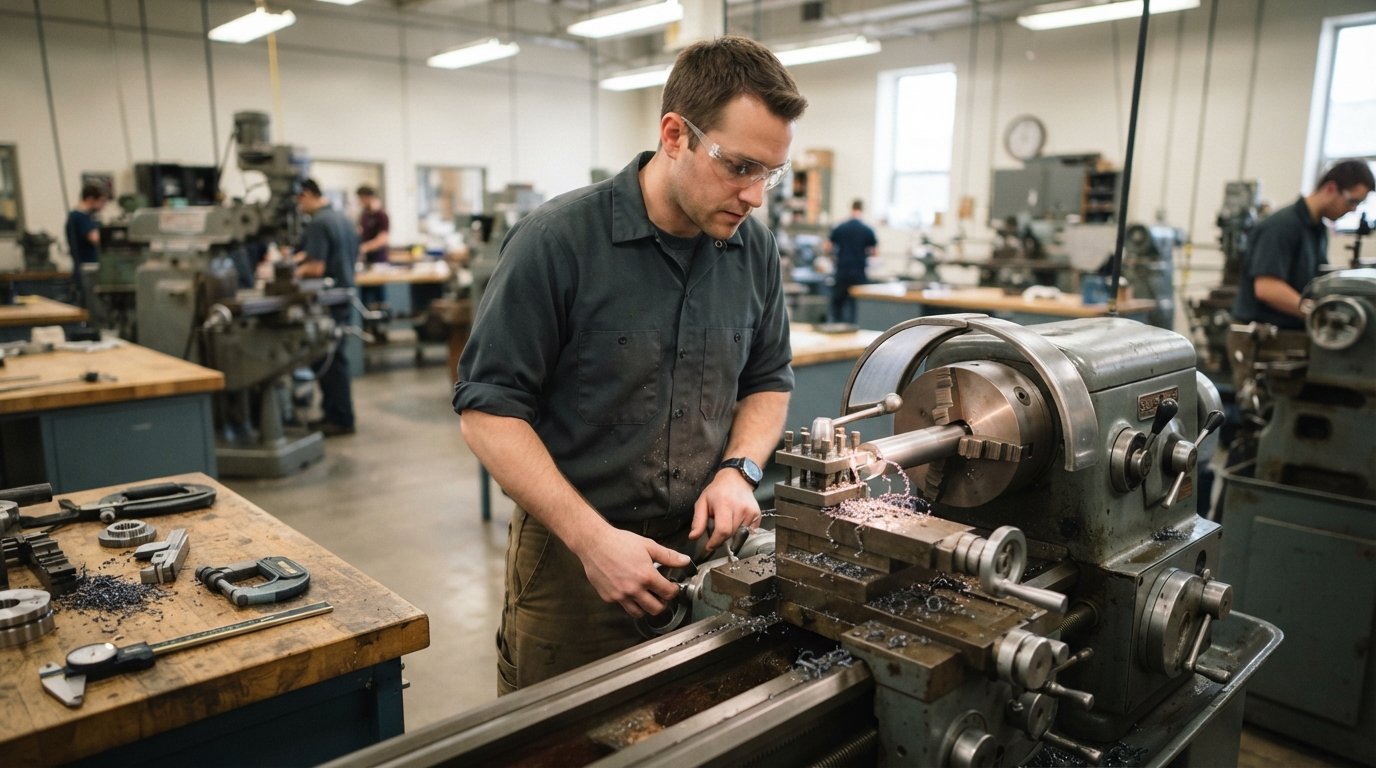
The certificate is designed as a standalone credential that can be completed in roughly 12 to 18 months, depending on course load and scheduling. At its core, the curriculum builds competence in conventional machine tools, precision measurement, blueprint reading, and safety protocols. You will spend significant time on lathes, milling machines, drill presses, and surface grinders, learning to produce parts that meet exact tolerances. Instructors emphasize shop math, geometric dimensioning and tolerancing (GD&T), and the importance of inspection throughout the manufacturing process.
Because modern shops increasingly rely on computer numerical control (CNC), the program typically introduces CNC programming and operation as well. Students learn to write basic G-code, set up tooling, and run simulated or actual CNC machines. This dual focus on manual and CNC skills makes graduates versatile: they can step into traditional machine shops or advanced manufacturing facilities. Coursework also covers materials science (ferrous and non-ferrous metals, plastics), heat treatment basics, and workflow management, giving you a holistic view of production.
Beyond technical skills, the certificate instills workplace habits that employers value: punctuality, teamwork, attention to detail, and a safety-first mindset. Many courses include project-based assignments where you build a portfolio of parts, which you can show during job interviews. The program is offered entirely in-person at Catawba Valley Community College, meaning you will have daily access to industrial-grade equipment and direct feedback from instructors who have worked in the field.
Core Competencies You Will Develop
By the end of the certificate, you should be able to demonstrate a range of competencies that map directly to entry-level machinist job descriptions. These include:
- Reading and interpreting engineering drawings, including GD&T symbols and tolerances.
- Setting up and operating manual lathes, mills, drill presses, and grinders safely.
- Using precision measuring instruments such as micrometers, calipers, and height gauges.
- Writing and editing basic CNC programs and performing machine setups.
- Applying shop math and trigonometry to calculate speeds, feeds, and dimensions.
These skills are developed sequentially: you start with safety and measurement, then move to manual machining, and finally progress to CNC. Each course builds on the previous one, so regular attendance and practice are critical. The in-person format allows instructors to correct technique in real time, which is difficult to replicate online.
Who Should Consider This In-Person Certificate
This program is ideal for individuals who prefer learning by doing and want to enter the workforce quickly. High school graduates who are not interested in a four-year degree will find a clear, structured path to a skilled trade. Adult learners and career changers who want to transition into manufacturing can leverage the certificate to gain credible, hands-on training in a relatively short time. Even those already working in production roles (assemblers, operators) can use the certificate to move into machining positions with higher pay and responsibility.
The in-person requirement is a strength, not a limitation: it ensures you get the supervised practice hours that employers expect. If you thrive in a collaborative, shop-floor environment and enjoy working with your hands, this could be a great fit. However, it is important to be realistic about the physical demands: machining involves standing for long periods, lifting moderate weights, and maintaining focus on detailed work.
For those who are unsure about committing to a certificate, a good first step is to explore broader vocational training options to understand how this program compares to other trade credentials. You can also speak with an advisor at Catawba Valley Community College to discuss your goals and assess your readiness. The college often offers information sessions or tours of the machine shop, which can help you visualize the learning environment.
Admission Requirements and Enrollment Steps
Admission to the Machine Shop Technology/Assistant Certificate program is generally open to anyone with a high school diploma or equivalent (GED). There may be placement tests in math and English to ensure you are ready for the coursework; if you need refresher courses, the college offers developmental classes. Because the program is in-person, you will also need to comply with any campus health and safety requirements.
The enrollment process is straightforward but requires attention to deadlines. Here is a typical sequence to follow:
- Complete the college application online and submit official transcripts.
- Take the placement test or provide SAT/ACT scores if available.
- Meet with an academic advisor to plan your course schedule and discuss financial aid.
- Register for classes during the open registration period and pay tuition or set up a payment plan.
- Attend orientation and purchase required safety gear (safety glasses, steel-toed boots, etc.).
Financial aid is available for eligible students, including Pell Grants, scholarships, and workforce development funding. Because the certificate is a credit-bearing program, it qualifies for federal student aid. The college's financial aid office can help you explore options and complete the FAFSA. Some employers also offer tuition reimbursement or apprenticeships that could offset costs.
It is worth noting that the program may have limited seats due to shop capacity, so applying early is advisable. The admissions team can provide specific deadlines and any additional requirements, such as a background check for certain manufacturing environments.
Career Outcomes and Job Outlook for Certificate Holders
Graduates of machine shop technology programs are in demand across a range of industries: automotive, aerospace, medical device manufacturing, energy, and general job shops. Entry-level positions include machine operator, CNC operator, and machine shop assistant. With experience and additional training, you can advance to setup technician, programmer, or lead machinist. The U.S. Bureau of Labor Statistics projects little to no change in overall employment for machinists, but the need for CNC-skilled workers remains strong due to retirements and automation.
In the Catawba Valley region, advanced manufacturing is a key economic driver, with companies constantly seeking skilled talent. The certificate's emphasis on both manual and CNC skills gives you an edge in the local job market. Starting salaries for machinists in North Carolina typically range from $35,000 to $45,000 annually, with opportunities for overtime and shift differentials. After a few years, experienced machinists can earn $50,000 or more.
It is important to remember that job placement is not guaranteed; your success depends on your performance, networking, and willingness to continue learning. The college's career services office can help with resume writing, interview preparation, and connecting with local employers. Many students secure jobs before graduation through internships or part-time work in local shops.
Comparing Certificate vs. Associate Degree
While the certificate gets you into the workforce quickly, some students choose to stack it into an Associate in Applied Science degree in Machining Technology. The associate degree adds general education courses and deeper CNC training, which can open doors to supervisory or engineering technician roles. However, the certificate is a smart choice if your priority is to start earning sooner. You can always return later to complete the degree, and credits typically transfer within the college.
Paying for Your Training and Finding Support
Cost is a major consideration for any educational program. Tuition for the certificate is based on per-credit-hour rates set by the North Carolina Community College System, which are relatively affordable compared to four-year institutions. Additional costs include textbooks, safety equipment, and possibly tools. Many students qualify for financial aid, and the college offers payment plans.
Beyond federal aid, look into local scholarships offered by manufacturing associations, community foundations, and employers. Some companies sponsor employees to attend the program in exchange for a work commitment. The college's workforce development division may also have grants for short-term training programs. To explore a wide range of online and campus degree options, including vocational certificates, you can use a free matching service like CheapOnlineEducation to compare programs and request information without obligation.
If you are considering a career in healthcare instead, our guide to a 12-week nursing assistant certificate at Durham Tech explains another fast path to employment, though it is a very different field. The key is to align your training with your interests and local job demand.
Is This Program Right for You?
Choosing a career path is a personal decision, and the Machine Shop Technology/Assistant Certificate, 1 year to less than 2 years In-person at Catawba Valley Community College is just one of many options. If you enjoy working with your hands, solving problems, and seeing tangible results, machining offers a rewarding career with room for growth. The in-person format ensures you get the hands-on practice and mentorship that employers value. Before enrolling, visit the campus, talk to instructors, and speak with current students or graduates to get a feel for the culture.
Take the next step by contacting the college's admissions office or visiting their website for program details and application deadlines. With careful planning and commitment, you can complete this certificate and launch a career in manufacturing in less than two years.