
CSU Bakersfield Electrical Engineering BS: 4-Year In-Person
Earn your Electrical and Electronics Engineering Bachelor's degree, usually 4 years In-person at California State University-Bakersfield. Hands-on labs, ABET accreditation, and career-ready skills await.

By Wendy Shaw
If you are drawn to circuits, power systems, or the physics of electronics, an Electrical and Electronics Engineering Bachelor's degree, usually 4 years In-person at California State University-Bakersfield, offers a structured, hands-on path into one of the most versatile engineering fields. CSU Bakersfield (CSUB) delivers this program through its School of Natural Sciences, Mathematics, and Engineering, combining rigorous theory with practical laboratory work. For students who thrive in a face-to-face environment and want to build a career in electrical engineering, this program is designed to provide the technical foundation and real-world experience employers expect. In this guide, we break down the curriculum, admission requirements, costs, and career outcomes so you can decide if this in-person degree is the right fit for your goals.
Why Choose CSU Bakersfield for Electrical and Electronics Engineering?
CSU Bakersfield is a public university located in California's Central Valley, a region with a growing demand for engineers in energy, agriculture, and manufacturing. The Electrical and Electronics Engineering Bachelor's degree, usually 4 years In-person at California State University-Bakersfield, stands out for its emphasis on applied learning and small class sizes. Unlike large research universities where students may sit in lecture halls with hundreds of peers, CSUB's engineering program offers more direct access to faculty and hands-on lab experiences from the early years.
The program is accredited by the Engineering Accreditation Commission of ABET, which ensures that graduates meet high standards of technical education. This accreditation is crucial for students who plan to pursue professional engineering licensure or enter industries with strict hiring criteria. The in-person format allows for collaborative projects, immediate feedback from instructors, and the use of campus laboratories equipped with modern instrumentation. For students who value a supportive learning community and want to stay in or near the Central Valley, CSUB provides a compelling option.
Another advantage is the university's strong ties to local industries. Bakersfield is home to major energy companies, agricultural technology firms, and manufacturing operations that frequently recruit engineering talent. The in-person modality facilitates internships, site visits, and networking events that can lead to employment after graduation. If you are considering a broader range of California programs, you might also explore our guide to Interdisciplinary Studies Bachelor's at Cal State LA, which offers a different approach to combining fields of study.
Program Overview and Curriculum
The Electrical and Electronics Engineering Bachelor's degree, usually 4 years In-person at California State University-Bakersfield, requires completion of 120 to 130 semester units, depending on elective choices and any remedial coursework. The curriculum is divided into lower-division foundational courses and upper-division specialized topics, with a strong emphasis on mathematics, physics, and engineering principles. Students typically begin with calculus, differential equations, and introductory physics, then progress to core electrical engineering courses such as circuit analysis, digital logic design, and electromagnetics.
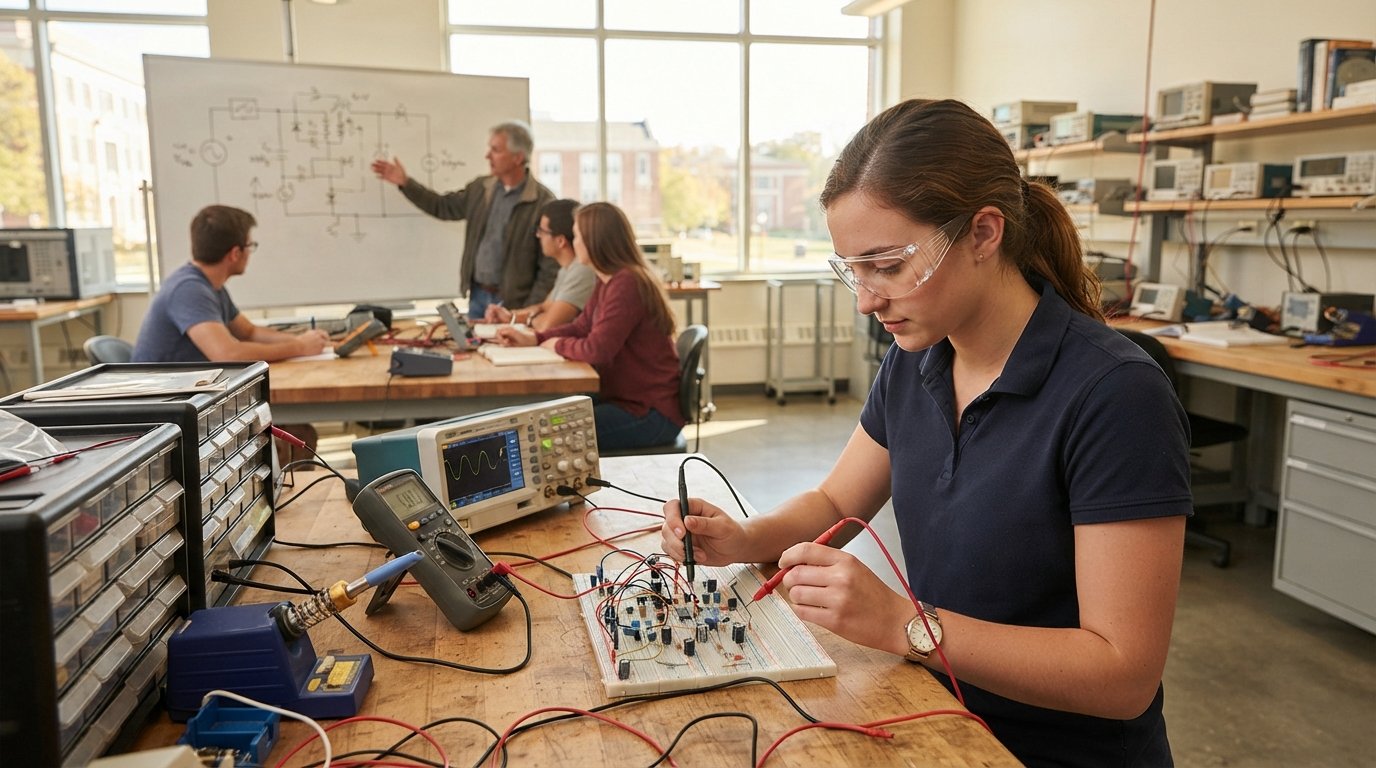
Upper-division coursework delves into areas like signals and systems, control systems, power electronics, and communication systems. Laboratory courses are integrated throughout the program, allowing students to apply theoretical concepts to real-world problems. For example, in a power electronics lab, students might design and test a DC-to-DC converter, gaining experience with oscilloscopes, function generators, and circuit simulation software. A senior capstone project is required, where students work in teams to design and implement an engineering solution, often sponsored by local industry partners.
Here is a sample sequence of major courses you might encounter:
- Freshman year: Calculus I and II, Introduction to Engineering, Physics I (Mechanics)
- Sophomore year: Calculus III, Differential Equations, Physics II (Electricity and Magnetism), Circuit Analysis I and II
- Junior year: Digital Logic Design, Microprocessors, Signals and Systems, Electromagnetics, Electronics I
- Senior year: Control Systems, Power Electronics, Communication Systems, Senior Design Project, technical electives
Students can choose technical electives in areas such as renewable energy, embedded systems, or robotics, tailoring the degree to their career interests. The program also includes general education requirements in humanities, social sciences, and communication, ensuring a well-rounded education. It is important to note that course availability may vary by semester, and students should consult with an academic advisor to plan their schedule effectively.
Admission Requirements and Application Process
Admission to the Electrical and Electronics Engineering Bachelor's degree, usually 4 years In-person at California State University-Bakersfield, follows the standard CSU application process. Prospective freshmen must meet the CSU eligibility index, which combines high school GPA and ACT or SAT scores (though CSU has temporarily suspended standardized testing requirements for some terms). Students should have completed college preparatory courses in mathematics (through pre-calculus or calculus), physics, and chemistry. Transfer students from California community colleges are encouraged to complete the Associate Degree for Transfer (ADT) in a related field or the Intersegmental General Education Transfer Curriculum (IGETC) to streamline admission.
The application is submitted through Cal State Apply, typically between October 1 and December 15 for fall admission. Supporting documents such as transcripts and test scores (if applicable) must be submitted by the stated deadlines. International students must also demonstrate English proficiency through TOEFL or IELTS scores. Because the program is in-person, applicants should be prepared to attend classes on the CSUB campus in Bakersfield. There is no online option for this specific degree, so students must make arrangements for housing and transportation.
For those who are exploring multiple degree paths, it can be helpful to compare programs at different institutions. Our article on the Interdisciplinary Studies Bachelor's at Cal State LA, linked earlier, provides insight into how another CSU campus structures its offerings. Additionally, if you are considering online alternatives for other fields, you can use a resource like CheapOnlineEducation to browse affordable online programs, though note that the CSUB electrical engineering degree is not available online.
Costs, Financial Aid, and Scholarships
The cost of attending CSU Bakersfield as an in-state undergraduate is relatively affordable compared to many private universities. For the 2025-2026 academic year, estimated tuition and fees for California residents are approximately $7,500 per year, while non-residents pay around $19,000 per year in tuition and fees. These figures do not include room and board, books, supplies, and personal expenses, which can add $12,000 to $15,000 annually. Students should budget for additional costs such as a laptop, scientific calculator, and lab fees for certain courses.
Financial aid is available through federal and state programs, including Pell Grants, Cal Grants, and student loans. The Free Application for Federal Student Aid (FAFSA) or California Dream Act Application (for eligible undocumented students) must be submitted by the priority deadline (usually March 2) to be considered for maximum aid. CSUB also offers merit-based scholarships for incoming freshmen and transfer students, as well as departmental scholarships for engineering students. The university's financial aid office can help students identify and apply for these opportunities.
Here are key steps to secure financial aid:
- Complete the FAFSA or CADAA by the priority deadline.
- Review your Student Aid Report and accept or decline awards through your student portal.
- Apply for CSUB scholarships through the university's scholarship portal.
- Consider part-time employment or work-study positions to cover incidental expenses.
- Meet with a financial aid counselor to discuss any special circumstances.
It is important to note that tuition and fees are subject to change, and students should verify current costs with the university's financial aid office. Additionally, the in-person format means students cannot save on costs by living at home if they reside far from campus, so housing expenses should be factored into the total cost of attendance.
Career Outcomes and Industry Demand
Graduates with an Electrical and Electronics Engineering Bachelor's degree, usually 4 years In-person at California State University-Bakersfield, are prepared for a wide range of entry-level engineering positions. The Bureau of Labor Statistics projects employment of electrical and electronics engineers to grow by 5 percent from 2022 to 2032, about as fast as the average for all occupations. In California's Central Valley, demand is particularly strong in the energy sector, with companies involved in oil and gas, solar power, and grid modernization seeking engineers who can design, test, and maintain electrical systems.
Common job titles for graduates include electrical engineer, electronics engineer, power systems engineer, control systems engineer, and test engineer. Employers may include utility companies, manufacturing firms, aerospace contractors, and government agencies. The median annual wage for electrical engineers was $103,320 in May 2022, according to the BLS, with the highest 10 percent earning more than $166,000. While salaries vary by industry and location, graduates from CSUB's program have a solid track record of finding employment in regional industries.
Internships and cooperative education experiences are strongly encouraged, as they often lead to full-time job offers. CSUB's Career Center provides resources such as resume workshops, job fairs, and on-campus interviews with employers. The in-person format allows students to participate in these events and build professional networks that can be invaluable when entering the job market. Additionally, the senior design project often serves as a portfolio piece that demonstrates practical skills to potential employers.
Is This In-Person Program Right for You?
Choosing between an in-person and online engineering degree depends on your learning style, lifestyle, and career goals. The Electrical and Electronics Engineering Bachelor's degree, usually 4 years In-person at California State University-Bakersfield, is ideal for students who benefit from face-to-face interaction with professors and peers, hands-on laboratory work, and a structured campus environment. If you are a recent high school graduate, a community college transfer student, or a working adult who can commit to daytime classes, this program offers a comprehensive and respected education.
However, if you need flexibility due to work or family obligations, you might explore online engineering technology or related degrees, though be aware that ABET-accredited online electrical engineering programs are limited. CSUB's program requires physical attendance for lectures and labs, so relocation or commuting may be necessary. Prospective students should visit the campus, meet with faculty, and speak with current students to determine if the environment aligns with their expectations.
For those who are still exploring different fields, resources like HigherEducationAdvisor.com can help you compare programs and request information from multiple schools without obligation. The site's matching tool allows you to filter by field of study, degree level, and location, making it easier to find programs that fit your criteria. While CSUB's electrical engineering program is just one option, it represents a solid choice for students seeking a rigorous, in-person engineering education in California.
Ultimately, the decision to pursue an Electrical and Electronics Engineering Bachelor's degree, usually 4 years In-person at California State University-Bakersfield, should be based on your career aspirations, academic readiness, and personal circumstances. With its ABET-accredited curriculum, supportive faculty, and strong industry connections, CSUB provides a pathway to a rewarding engineering career. Take the time to research thoroughly, reach out to admissions advisors, and consider how this program aligns with your long-term goals. Your future in electrical engineering may start right here in Bakersfield.