
Clinical Assistant Associate's Degree at Bossier Parish CC
A two year clinical assistant associate's degree at Bossier Parish Community College combines hands on training with real patient care skills employers need.

By Margaret Reis
A medical or clinical assistant associate's degree, usually a 2 year in person program at Bossier Parish Community College, gives you a direct route into one of the fastest growing roles in American healthcare. You walk into a clinic, a hospital outpatient unit, or a private practice on day one knowing how to take vitals, update charts, assist with exams, and keep the front office running. That combination of clinical and administrative skill is exactly what employers say they cannot find fast enough.
If you are weighing your options, you are probably asking two questions at once. Is a two year commitment worth it compared with a shorter certificate? And why would you choose an in person program at a specific community college instead of an online alternative? The answers come down to how much responsibility you want, how quickly you need to earn, and how comfortable you are learning hands on skills through a screen.
This guide walks through what the Bossier Parish Community College pathway looks like, what you will study, what it costs in time and money, where graduates work, and how to decide whether this is the right move for you in 2026.
Why a Two Year Associate's Degree Beats a Short Certificate for Many Students
A certificate program can get you into an entry level medical assistant role in under a year. That is a real advantage if you need income fast. But the associate's degree, usually completed over two years of in person study, opens doors that certificates often leave closed. Many hospitals, large clinic networks, and specialty practices now list an associate's degree as a preferred or required credential for clinical assistant positions, even when state law does not mandate it.
The difference shows up in three places: pay, scope, and promotion. Employers frequently pay associate degree holders more per hour, assign them more complex clinical tasks, and consider them first when a lead medical assistant or office coordinator role opens up. If you plan to stay in healthcare for a decade or more, the extra year of school often pays for itself within a few years of graduation.
There is also a practical credentialing angle. Most medical assistant certification exams, including those from national certifying bodies, require completion of an accredited program. An associate's degree from a regionally accredited community college satisfies that requirement and gives you a transcript that transfer friendly four year schools recognize if you later decide to pursue a bachelor's degree in health administration or a related field.
What the Bossier Parish Community College Program Actually Involves
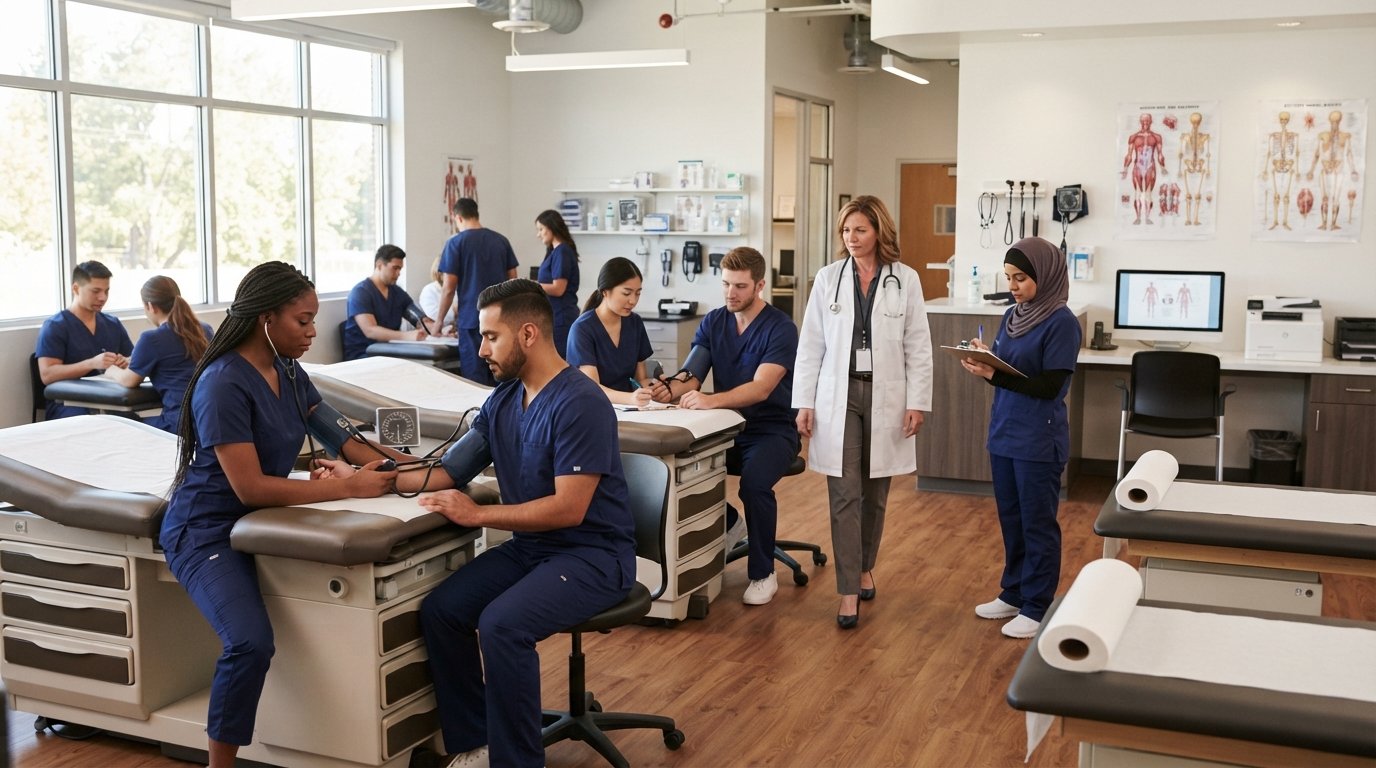
Bossier Parish Community College, located in Bossier City, Louisiana, offers a medical and clinical assistant pathway designed to be completed in roughly two years of full time, in person study. The program blends classroom instruction with laboratory practice and a supervised clinical externship, which is the part employers care about most. You do not just read about drawing blood or performing an EKG; you practice on classmates under instructor supervision and then perform those skills in a real clinical setting before you graduate.
Coursework typically covers medical terminology, anatomy and physiology, clinical procedures, pharmacology basics, medical office administration, billing and coding fundamentals, and electronic health records. The in person format matters here because clinical skills are physical. You learn body mechanics, injection technique, sterile field setup, and patient communication by doing them, not by watching videos.
Students who want a broader view of the administrative side of healthcare often pair this training with additional credentials. For example, a medical records admin certificate from a CT community college covers health information management in more depth, which can be useful if you eventually want to move into records, compliance, or front office management rather than direct patient care.
Admission Requirements and Prerequisites
Most community college allied health programs, including this one, require a high school diploma or equivalent, placement testing in math and English, and completion of prerequisite courses such as basic biology or medical terminology before you enter the core clinical sequence. Some programs also require a background check, immunizations, and CPR certification before the externship begins. Because clinical seats are limited, admission is often competitive and may follow a selective or point based process.
It helps to meet with an academic advisor early. Advisors can map out which prerequisites you can take in a single semester, whether developmental math or writing courses will add time, and when the next clinical cohort starts. Planning one or two semesters ahead prevents the most common delay: finishing prerequisites too late to enter the clinical sequence on schedule.
Cost, Financial Aid, and Return on Investment
Community college tuition is one of the best values in higher education. For Louisiana residents, per credit hour costs at a public two year college are a fraction of what a private career school charges for a comparable medical assistant diploma. Add fees, books, uniforms, a stethoscope, and certification exam fees, and the total is still typically a small fraction of a four year degree.
Financial aid options usually include federal Pell Grants, Louisiana state aid programs, institutional scholarships, and work study. Because the program is credit bearing and accredited, you can generally use federal student aid if you qualify. Many students also work part time while enrolled, since classes are scheduled during the day and the program is local.
The return on investment calculation is straightforward. Compare the total program cost against the starting hourly wage for medical assistants in your area, then factor in the higher ceiling that an associate's degree provides over a certificate. In most Louisiana markets, graduates recoup their tuition within a few years, and the degree continues to pay dividends through promotion eligibility.
Career Outcomes: Where Clinical Assistants Work and What They Earn
Graduates work in a wide range of settings. The most common are private physician offices, urgent care clinics, hospital outpatient departments, specialty practices such as cardiology or dermatology, and community health centers. Some graduates move into school based health clinics, occupational health, or medical billing and coding roles after gaining experience.
Typical duties include:
- Recording patient history and vital signs before the provider enters the room
- Preparing patients and instruments for exams and minor procedures
- Drawing blood, collecting specimens, and performing basic lab tests
- Administering injections and medications as directed by a licensed provider
- Updating electronic health records, scheduling appointments, and handling insurance paperwork
Pay varies by region, setting, and experience. Hospital and specialty practice roles generally pay more than solo physician offices, and certified assistants earn more than uncertified ones. The Bureau of Labor Statistics projects solid growth for medical assistants over the next decade, driven by an aging population and the expansion of outpatient care. That demand is one reason the associate's degree remains a stable investment even when other fields slow down.
For students who want to compare this pathway against other healthcare and administrative programs, a college matching site such as TopStudents lets you browse sponsored online and on campus options by subject and state, request information, and compare costs before committing. It is a low pressure way to see what else is available alongside the Bossier Parish route.
In Person vs Online: Why the Format Matters for Clinical Training
Online education has transformed many fields, but clinical assisting is not one of them, at least not for the hands on portion. You cannot learn to draw blood, position a patient for an EKG, or sterilize instruments through a video lecture. That is why the Bossier Parish program, like most accredited clinical assistant programs, delivers its core courses in person and requires a supervised externship.
That said, some general education courses, such as English composition, psychology, or medical terminology, may be available online or in a hybrid format. Taking those courses online can free up your schedule for the clinical labs that require your physical presence. If you are balancing work or family obligations, ask an advisor which courses can be completed remotely and which cannot.
The in person requirement also has an upside beyond skill building. You build relationships with instructors who have worked in the field, practice communicating with patients under supervision, and get direct feedback on your technique. Those relationships often turn into job leads, because clinical instructors frequently maintain connections with local employers who hire from their programs.
How to Decide If This Pathway Is Right for You
This program fits people who want to work directly with patients, enjoy variety in their day, and prefer a structured, two year path to a stable career. It also suits career changers who need a credential that employers recognize without spending four years in school. If you dislike hands on work, prefer a fully remote job, or want to avoid patient contact, a different healthcare pathway such as health information management or medical billing may fit better.
Here is a simple framework to evaluate your fit:
- Confirm you are comfortable with direct patient contact, including blood draws and minor procedures.
- Check that you can commit to two years of in person classes plus an externship, including daytime availability.
- Compare total program cost at Bossier Parish against local certificate programs and private schools.
- Talk to an advisor about prerequisite timing so you do not lose a semester.
- Ask about job placement support and which local employers hire program graduates.
If most of those answers point in the same direction, the associate's degree is likely a strong choice. If several answers raise doubts, explore adjacent programs before committing. The worst outcome is enrolling in a clinical program and discovering during the externship that patient care is not for you.
Steps to Enroll at Bossier Parish Community College
The application process is straightforward but has deadlines. Start by applying to the college, submitting transcripts, and taking placement tests if required. Then meet with an allied health advisor to map your prerequisite courses. Once prerequisites are complete, you apply separately to the clinical program, which may include a competitive selection process, a background check, and health documentation.
After acceptance, you register for the clinical sequence, order uniforms and supplies, and complete CPR and immunization requirements before the externship. The final semester typically includes the supervised clinical placement, which often leads directly to job offers. Many students begin applying for positions a few months before graduation so they can start working soon after completing the program.
One more practical tip: keep every syllabus, certification card, and externship evaluation in a folder. When you apply for certification and your first job, you will need documentation of your training hours and skills. Having it organized saves weeks of scrambling later.
A medical or clinical assistant associate's degree, usually completed in two years of in person study at Bossier Parish Community College, is one of the most direct paths into a healthcare career that combines patient care with real responsibility. It costs far less than a four year degree, takes less time than many alternatives, and leads to a role that employers across Louisiana and beyond are actively hiring for. If you are ready to move from considering the idea to planning the steps, the next move is simple: contact the college, talk to an advisor, and find out when the next clinical cohort begins.